Wednesday, 24 March 2021

 Chapter 2.       (continued)


                   Artist Dosso Dossi's imagining of Greek Philosopher, Democritus 


                                             (Credit: Wikimedia Commons)


At this point, some social scientists respond to their critics with further, more aggressive counterattacks of their own. They argue that no science, not Physics itself, is “objective”. Cultural biases shape all human thinking – including that of physicists. For example, over a century ago Western physicists postulated, and went looking for, what they called “atoms”, because early in Western history, a philosopher named “Democritus” had postulated the idea that the world is made of atoms. Once instruments capable of reaching into very tiny levels of matter became available, Westerners already had the concept that enabled them to imagine and set up experiments at that level. It had been planted there during the educations they acquired in their cultures. But Democritus did not derive the idea of the atom from observations of any “atoms”. The idea was a product of his culturally shaped imagination.   


Thus, these social scientists argue that the overarching view called relativism is the only logical one to adopt when we study the body of social science research (or all research in all fields, for that matter). We can try to observe human societies and the belief systems they instill in their members (Western science being just one example of a belief system), but we can’t pretend to do that work objectively. We come to it with eyes already programmed to notice in the details around us the patterns we consider “significant”. We see as we do because of beliefs we absorbed as children. Every scientist’s model of what the world is lies deeper than her ability to articulate thoughts or even just observe. Cultural bias can’t be suspended; it preconfigures our ability to observe or think at all.


The whole of reality is much more detailed and complex than the set of sights, sounds, etc. any one of us is paying attention to. Other folk from other cultures notice different details and construct different pictures of reality. Some of the pictures are radically different from ours, but they are still quite workable.


In short, any human view of the world, and especially any culture-wide model believed and used by any human society, is inherently biased. This is the stance taken by most social scientists: even Physics, they say, is made of opinions.  


Some social scientists go so far as to claim there aren’t really any “facts” in any of our descriptions of past events or even of events happening around us. There are only various sets of details noticed by some of us; these are filtered through values and concepts we learned as children. Within each culture, people group these details to form a “narrative”. Thus, as we go from culture to culture, social scientists say, we see that any one of these narratives is as valid as any other.


So, at the level of large generalizations about what is “right” and what is “wrong”, social scientists not only have nothing to say; social scientists insist that nothing objectively true can be said. “Science” is just a Euro-based set of theories that seem to work most of the time. For now. But it is not true in any ultimate sense of the word. 


Scientists in the sciences other than the social ones continue to assert that there is an empirical, material reality out there that is common for us all and Science is the most reliable way we have to understand that reality. But scientists in all branches of Science admit that they can’t give a very good explanation or model of what “right” and “wrong” are – if such things can even be said to exist.


In a further rebuttal of relativism, however, scientists in the physical sciences and life sciences assert that the idea that Science can’t give us any useful insights into how any parts of the world work is nonsense. Science works. Its successes have been so large and so many that no sane person can doubt that claim.


In this complex picture lies the dilemma of the West in modern times. Back and forth, these arguments called the Science Wars continue to rage. I’ve touched on a few of them, but there’s not enough space here to go into even five percent of the whole controversy.


So what’s the bottom line? The point of all the discussion so far in this chapter?


The point is that Yeats was right: the best really can lack all conviction. They can even reject the whole idea of anyone having any “convictions” ever. Thus, many social scientists can read about customs like honor killings and remark, “Well, that’s their culture.” In fact, for many thinkers today in the universities, all convictions are temporary and local. (A more sensible compromise position is taken by Marvin Harris in Theories of Culture in Postmodern Times.5)


This has been the scariest consequence of the rise of Science: moral confusion and indecision in, first, our intellectual elites and, then, the whole of Western society. This confusion began to become serious in the West in the nineteenth century after Darwin and the granddaddy of all relativists, Nietzsche, who basically argued that the human world is indeed a mess, and the only thing that brings any kind of order to it is the will of a hard-driven, visionary individual. This he argued back in the late 1800s. And here we are in the twenty-first century, and the crisis of moral confidence is getting worse. No educated person in the West wants to say what “right” is anymore.


Now, all of this still may sound far removed from the lives of ordinary folk, but the truth is that relativism’s effect on ordinary people’s lives is crucial. When a society’s sages can’t guide its people, people look elsewhere for moral leaders. When the philosophers and social scientists respond to their fellow citizens’ queries about morality with equivocation, or flatly refuse to answer the queries, others – some very unwise – move in to fill the demand in the ideas marketplace.


(In case the larger point here is not clear, this is a good place to stress again that the main aim of this book is to articulate a moral code that all humans can live by. One we can choose to follow because we can see by reasoning and evidence that it explains the cultural diversity that we see and that, therefore, it will likely work. It will get us to a world society that is both peaceful and vigorous.)


So, now we must ask: how has this growing moral paralysis since Darwin, Nietzsche, and Freud affected ordinary folk? How has the eroding of our old moral codes affected real people’s lives? What consequences did people who lived in the growing moral emptiness of the last hundred years have to endure?


Notes


1. Ruth Benedict, “Anthropology and the Abnormal,” Journal of General Psychology,          10 (1934). 

http://www.colorado.edu/philosophy/heathwood/pdf/benedict_relativism.pdf.


2. Thomas Kuhn, The Structure of Scientific Revolutions (Chicago: University of Chicago Press, 3rd ed., 1996).


3. John Searle, Minds, Brains and Science 

(Cambridge, MA: Harvard University Press, 1984).


4. Harold Kincaid, Philosophical Foundations of the Social Sciences: Analyzing Controversies in Social Research, (New York, NY: Cambridge University Press, 1996).


5. Marvin Harris, Theories of Culture in Postmodern Times (Walnut Creek, CA: AltaMira Press, 1999).


Tuesday, 23 March 2021


        A clash of cultures: skulls of buffalo shot by U.S. government hunters, 1880’s   

                                 (credit: Wikimedia Commons) 


Chapter 2.  (continued) 


In response to the criticisms of the “unscientific” nature of their discipline, some social scientists have tried hard to be more rigorous in their work. However, many have admitted Searle is at least partly right. For example, studies done in Anthropology are usually difficult to replicate for an array of reasons. Thus, replicating of research in social science is almost never possible. 


Here let’s recall that, in order to qualify as “scientific”, a model or theory must be testable in the material world, and the tests must be replicable. If the tests can’t be replicated, the theory is not Science. Tell me how you test your theory. Then, I can check it by doing those tests myself. Easy to do in Physics and Chemistry where materials and pieces of apparatus are standardized. Very difficult most of the time in Sociology and Anthropology.


Many factors make social science’s studies hard to replicate.


First, background conditions of studies in social science often can’t be reset. Socially relevant facts keep changing. For example, how could a tribe return to living as fishers if the species they once caught off their coasts are gone?


In social science, we also accept implicitly that, even when conditions in the world can be “reset”, no custom should ever be forced on a tribe. For example, trying to get a tribe to go back to living naked once they have chosen to wear clothes would be unethical. Tribes in the Amazon, once they join a society where clothes are worn, don’t want to live naked anymore. Cultural anthropologists would not try to make these people go back to living naked, as they had been living just a few years before. The anthropologists’ own moral code tells them that trying to “guide” changes in a tribe’s way of life to aid research – or for any other purpose – is wrong. Social scientists are ethically bound to observe societies as the people in them live, but never to interfere in their changes.    


In addition, a researcher’s own biases influence what she looks for and how she sees it. These biases are impossible to avoid, no matter how carefully the studies are designed. People of the Amazon see trails of peccary or cayman in crushed grasses. But Western anthropologists see details they have been programmed to notice (e.g. flowers, insects). An anthropologist living with an Amazon tribe needs years of training before she can learn to skilfully track peccaries.  


Finally, a social scientist’s watching a tribe of people also changes what is being watched, namely the morés of those people. For example, an anthropologist in the field usually can’t work without shoes. Often in only weeks, the folk she’s living with and studying, if they have been living barefoot, start to want shoes.  


For all of these reasons then, social scientists admit they often must settle for what is really a single occurrence of the social phenomenon they wish to study. One that can’t be replicated. But no generalizations can be drawn from a single, unrepeatable instance of anything. That’s a direct contradiction of what the word “generalize” means.


These difficulties with social science research put us in a logical quandary.


Societies vary widely in their beliefs and morés, and those morés keep changing even while scientists are studying them. There are many human tribes to study, and each contains many customs that are changing all the time. Social scientists will never adequately document all the societies of the world as they are now.


Thus, we’ll never arrive at any useful conclusions in social science unless we can first propose larger, more generic theories of how human societies work. (The main aim of this book is to arrive at that more generic model of social systems and how they work. But first we'll explain why we need that model so.)


In fact, most social scientists see that kind of plan as being immoral from its outset because it amounts to Europeans imposing their ways on other cultures. In the meantime, critics of social science say such a grand theory can’t be formulated. They insist that social science is too vague, from its terms on up, to ever enable its practitioners to create a general theory of how societies work.


If such a theory ever were articulated, it would give direction and focus to all social science work. Under it, social scientists could propose and test specific hypotheses. But until social science has a comprehensive theory to guide its research, it will remain what Ernest Rutherford, the great physicist, dismissively called “stamp collecting”: people recording data but making no attempt to explain them.


Monday, 22 March 2021


Chapter 2                      The Moral Emptiness of Science


                                  William Butler Yeats (credit: Wikimedia Commons)


Things fall apart; the centre cannot hold;

Mere anarchy is loosed upon the world,

The blood-dimmed tide is loosed, and everywhere

The ceremony of innocence is drowned;

The best lack all conviction, while the worst

Are full of passionate intensity.


—from “The Second Coming” by W.B. Yeats, 1919


In the West, when our idea of God began to erode, so did our ideas of right and wrong, and when those ideas began to erode, we became the society that Yeats described in his great poem “The Second Coming”. We live in a time in which some truly immoral citizens are filled with “passionate intensity”. Fraudsters claim they are daring entrepreneurs; Mafia thugs claim that they are soldiers in one more kind of war; warmonger generals tout their own indispensability. In short, these people see themselves as moral, even heroic.


In the meantime, some of what should be society’s most moral citizens “lack all conviction.” For example, it would seem logical that people looking for moral direction in the Science-driven countries of the West would turn to their gurus, i.e. scientists. Especially scientists who study human societies and their moral beliefs. In the West, these experts are our anthropologists and sociologists. Trained to make astute, Science-based judgments about human societies and their “ways of life”, social scientists should be our most morally gifted citizens.


But social scientists in the West have no moral directions to offer the rest of us. In their writings, they flatly deny that moral values refer to anything real at all. As I noted in our previous chapter, American anthropologist Ruth Benedict put it succinctly: “Morality differs in every society and is a convenient term for socially approved habits.” Thus, as moral guides, Science and scientists (social scientists, in particular) appear to be pretty close to useless.


How can this be? Ordinary people in societies and tribes all over the world, when they are asked to explain their actions, answer by giving the moral codes they learned in their childhoods. It seems clear then that Social Science ought to be studying those moral codes if it wants to explain why people in tribes and societies do the things they do. But in response to questions about what moral codes are, and how they relate to humans’ actions, social scientists say that moral codes have no basis in the real world. Moral claims are just expressions of tastes, like a preference for one brand of ice cream over its competitors. Statements about “right” and “wrong” are just ways of venting emotion. Right and wrong are empty concepts, unrelated to the observable facts of Science. These experts then go so far as to challenge their opponents to prove otherwise. 


Many even go over to the offence and ask what it is that all Science is seeking. Are scientists seeking perfect truth about reality? That, by pure logic, is unattainable. But, if not truth, sociologists ask, then what is Science seeking?


Thomas Kuhn’s The Structure of Scientific Revolutions (1962) is arguably the most influential work on this topic. In it, he casts a dark shadow over Science’s view of itself. He argues that all branches of Science move forward via processes that are not rational. The scientific method is driven not by logic, which can be very clearly defined, but by intuition, which long has been a nebulous concept. Science does not progress by a controlled march of improving knowledge. Instead it moves from less useful pictures of reality to more useful ones by unpredictable leaps that he calls paradigm shifts


A paradigm shift occurs in a branch of Science when many individuals in that branch, separately, each have a moment of insight and then experience a leap of understanding so profound that it makes them literally see reality in a new way. The insight for most of them will have been triggered by things they have read by some fellow scientist. But they cannot tell you after their cognitive leap has occurred exactly how it happened and how they then came to grasp this new picture of the world.


Scientists who grasp a paradigm shift do indeed come to “see” the world in a new way; their minds are reprogrammed to see different patterns in the details around them. That’s how profoundly the new model, once they learn it, affects them. Each scientist who “gets it” experiences a kind of “conversion” that steers her into a new way of seeing reality and into a community of fellow believers.


In all branches of Science, Kuhn claims, old ways of thinking are dropped and new models become accepted ones via this process that appears to be driven at least as much by non-rational mental leaps as by rational steps like hypothesize, test, and repeat. The modes of thinking that enable Science to evolve run deeper than reasoning and evidence can explain. Kuhn gives many examples from the History of Science to support his case. His work has evoked many responses, pro and con, and there is no doubt that he has shone a troubling light on the reliability of all of Science.2 In short, Science is not done “scientifically”.


In the meantime, counterattacks aimed back at the social sciences are made by critics like philosopher John Searle. He admires the physical sciences because, he claims, they can be logically rigorous. Physical sciences, he says, describe their theories and the studies designed to test them using unambiguous terms. (One calorie heats one gram of water one Celsius degree.) But the social sciences use terms that are too vague to support rigorous reasoning. (In Anthropology, what makes a “band” or a “big man”?) Thus, conclusions reached in social science are not reliable.3 (Critics of social science are well countered in Harold Kincaid’s Philosophical Foundations of the Social Sciences.4)

Saturday, 20 March 2021


                                                  Chapter 1 (last portion) 


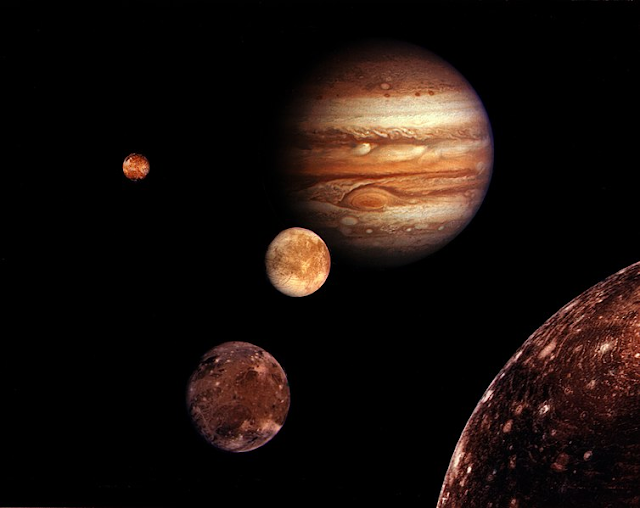
                               artist's imagined montage of Jupiter and 4 of its moons

                                              (NASA/JPL via Wikimedia Commons) 


If we consider just these three scientific theories – of Copernicus, Darwin, and Freud – what can we say have been their consequences? Copernicus, Galileo, and Newton, for most people, removed the biblical God from their picture of the cosmos. They didn’t need him in their model. Darwin removed God as the creator of life. He even reduced humans to just one more kind of animal. And Freud made humans look like sick animals, easily deluded by their own lustful, aggressive, self-absorbed thoughts. (Palmer articulates this idea well.7)

Despite all this, Science has not proved that a universal moral code is impossible or that the existence of God is impossible. But over the past four centuries, Science has badly shaken traditional ideas of God and thus, also, traditional ideas of morality. (The two are deeply intertwined, as we shall see.)

However, let me stress again that what does not follow from these scientific models is that there is no God or that all forms of theism and all moral codes are wishful thinking. We just need a new understanding of what right and wrong are. Then, we can reason our way to a new view of God.

But for now, we can say that Science has almost levelled the pre-Enlightenment ways of thinking of these things. And let’s make no mistake about what the loss of their belief in God has done to the masses of ordinary people. Removing God from Western society’s generally accepted picture of how this world works had the inevitable consequence of ending our society’s confidence in its moral code. We lost confidence in our ideas of what right and wrong are and how we should try to act, toward the world in general, but especially toward each other. 

If the moral rules we’re supposed to follow aren’t God’s rules, whose rules are they? Human authorities’ rules? Which human authorities? Who are they to be telling me what to do? They’re human, like I am. I know all humans make mistakes. Therefore, I’ll work out my own moral code. Thank you, anyway.

And perhaps it is worth pointing out here that there are still people who believe that the Earth is the center of the universe, and God made the universe in six days and rested on the seventh, and the miracles described in the Bible really did happen, parting a sea, walking on water, and all. But the trend of the last five hundred years is unmistakable. More and more people are having less and less confidence in the old ways of explaining the world.

The point may seem a trivial one to many people today. Why should we care whether the old ideas of God and right and wrong are crumbling? But it turns out that our caring about these matters is vitally important. If we don’t believe in Christian moral codes anymore, then they must be replaced with something. Our moral codes enable us to live together in communities and just get along. That space in our lives can’t stay empty. A moral code is not a luxury to be used and enjoyed when we have time for it. A moral code is what we consult just to move through ordinary days. What matters? What doesn’t? What should I do about these things? Every moment of every day of ordinary experiences.  

Explaining in more detail how morally vacant Science has been – so far – and why humans all over the world are struggling to cope with the loss of their moral codes, even though they may not be aware of the philosophical names for the thoughts they are having – will be the business of our next chapter.


Notes


1. Barbara Hanawalt, Growing Up in Medieval London (New York: Oxford University Press, 1993), p. 55.

2. “Life Expectancy,” Wikipedia, the Free Encyclopedia. Accessed March 29, 2015.http://en.wikipedia.org/wiki/Life_expectancy.

3. René Descartes, The Passions of the Soul, Articles 211 and 212, ed. Jonathan Bennett. http://www.earlymoderntexts.com/pdfs/descartes1649.pdf.

4. Ibid., Meditations on First Philosophy, Meditations 3 and 4., trans. John Veitch, 1901.http://www.classicallibrary.org/descartes/meditations.

5. Sigmund Freud, Introductory Lectures on Psychoanalysis, ed. James Strachey (New York: W.W. Norton & Co., 1966), p. 353.

6. Cathryn Delude, “Researchers Show That Memories Reside in Specific Brain Cells,” MIT News, March 22, 2012. http://newsoffice.mit.edu/2012/conjuring-memories-artificially-0322.

7. Donald Palmer, Does the Center Hold? An Introduction to Western Philosophy (California: Mayfield Publishing Company, 1st edition, 1991), p. 56.


Friday, 19 March 2021


                                   Sigmund Freud (credit: Wikimedia Commons) 


All of this may seem bad enough, but it gets worse. The third significant way in which Science eroded Religion came when Science began to understand the workings of the human brain. Humans had long felt that many things in this world could not be explained in scientific terms because they had long known that inside the privacy of their minds, which both Science and daily experience had shown resided in their brains, they had dreams and feelings that, by Science alone, made no sense. Even in physical reality, away from all dreams, they sometimes saw or did strange things that seemed to have no logical explanation.

Cruel or lustful thoughts and acts were bad enough, but at least they seemed somewhat predictable, given humans’ “sinful” nature. From long experience, we’ve come to know our human drives, so we can accept intermittent thoughts of fornication, theft, violence, and murder as natural. The traditional wisdom had explanations for them all. We are morally “fallen” creatures, the Bible says.

But people also have weirder dreams and even see weird things when they’re awake that, by the laws of both Science and common sense, are not possible.


                                  The Nightmare (Fuseli) (credit: Wikipedia)  


Why do people have dreams and waking visions of angels or demons hovering in the air, or of talking cats on mountaintops, bathed in orange light and standing on their hind feet? Night after night, many of us dream not just cruel or lustful dreams, but also many more that are simply absurd. Other people, wide awake, see angels, demons, and miracles. For centuries, if a person saw or did something that afterward he himself could not make sense of, the accepted explanation was that God (or Satan) had caused the event or made him do the deed. Much of normal human experience, apparently, lies beyond Science and even beyond common sense. In those times, “The Devil made me do it!” was an acceptable explanation for otherwise unexplainable behavior.

When Freud came along, his big contribution to human knowledge was simply the proposition that all these perceptions come from inside the brain of the person having the dream or vision. Thus, visions and miracles can be easily explained. They come from stored-up memories that combine and recombine to form narratives that are driven by deep, unconscious needs – needs that the visionary isn’t aware of because they are buried so deeply, he can’t consciously access them, no matter how he tries. Under stress, his brain transmits images into his optic nerves – the opposite of what normally happens. So even wide awake, we sometimes see what in physical reality is not there.

Most of our memories are not recallable at will, but they are all in there. Unless a person has had some brain-destroying injury or disease, her brain holds all she has ever experienced, all the sense data that have ever been fed into her brain via her vision, hearing, touch, smell, and taste. How they will affect her moment-by-moment flow of consciousness can’t be predicted in advance, but the patterns in “paranormal” experiences coincide too often and too closely with the subject’s personal issues for us to believe that those experiences are somehow independent of the mental states that preceded them. 

People have visions of angels when they have been reading about miraculous cures for the very illnesses under which they have lately been suffering. They dream of tidal waves after watching a TV show about a recent big one in Japan. They see ghosts of their dead fathers after days of feeling guilty about how they neglected him while he was alive – the dream coming just before what would have been his 80th birthday. The sciences of the mind have shown us – with evidence – that we can literally see what we want to see.

While at first, Freud and his followers were considered to be sex-obsessed crackpots, they soon began to gain credibility and command respect, mainly because they were getting results. Their models could explain all of human behavior, they could make high probability predictions about how individuals with certain backgrounds would act in specific future situations, and they began to cure people of neuroses and psychoses that, in earlier times, would have been pronounced hopeless.

Then, as research on the human brain advanced, other researchers showed that the model portraying all of a person’s experiences as being stored in his brain – even though he can’t recall the experiences at will – is literally true. Patients willing to stay conscious during neurosurgery and allow researchers to place tiny electrodes on their brains are able, when milliamp currents are turned on, to recall all kinds of memories which they are ordinarily not aware of.6

Freud went much further with his psycho-sexual explanations of nearly all of the motives that drive human behaviour. Much of what he had to say has today been discredited; for example, we no longer believe little girls are consumed with a desire to have a penis. But the larger impact of his discoveries remains. Those parts of human experience that for so long had seemed to defy both logic and common sense can now be explained rationally. The dreams and visions are products of overactive human imaginations; they never actually took place.

No more dreams sent from God. No more waking visions. No more miracles.

Thursday, 18 March 2021


                                                             Charles Darwin 

                (credit: George Richmond [Public domain], via Wikimedia Commons)


In the mid-1800s, Charles Darwin hit the faithful and their institutions and beliefs with Science’s second blow to the body of traditional belief, probably the biggest of all the jolts. He gave an excellent scientific explanation for life itself. He showed that over the course of millions (perhaps billions) of years, life evolved from a few simple cells to complex organisms made of trillions of cells.

Darwin had the theory, and he had the evidence to support it. The models of genetic variation and natural selection can explain all life forms on Earth in all their many subtle variations. Fossils in the rocks all over the world show the stages through which life has developed and spread. Chemical and physical tests of fossils give consistent, predictable results that clearly support Darwin’s theory. Life, in all its complex forms on this earth, developed very gradually, from a few simple cells, through myriads of forms, over billions of years.

Where was the Bible then? The first book of the Bible, Genesis, portrays all the history of the pre-human universe as happening in six days. The Darwinian Theory of Evolution says this picture is silly. Furthermore, the theory implies that natural physical processes – ones that can be observed, measured, predicted, and even manipulated – can account for all the phenomena in reality, living and non-living. For scientists, the Bible is not needed in their discussion of what the universe is or what human beings are. The Bible, for Science, is pretty much irrelevant.

Darwin’s Theory of Evolution was a shock of such magnitude that Christian authorities and most of the faithful who listen to them are still reeling from it and still lashing out at it. Scientists who believe the theory gives a true picture of reality find these attacks annoying. The evidence is there – mounds of it. What evidence is there for the alternative explanation? One old book, written by a bunch of priests, prophets, and disciples with vested interests and sinecure jobs to protect, making claims about events they did not witness, events that can’t be replicated, examined, or tested. It just isn’t Science.

In fact, how can the “faithful” – who every day derive most of the comforts of their way of life from the ideas, discoveries, and inventions of scientists – be such ingrates? It’s a sure bet that however much they may want to criticize the broad range of studies and activities called “Science”, they don’t want to starve, and they don’t want their electricity turned off. They certainly don’t want to be eating tainted food, shivering in a hovel by a wood fire, watching their children die of mysterious “miasmas”.

In spite of all of these accusations, however, a main intention of this book is to show that the full description of both sides of this nasty quarrel is more complex than what my last couple of paragraphs portray. For now, this small section on the Theory of Evolution can be summarized by saying that Darwin’s theory, for most thinking people, floored the Bible for the count. He had found a theory that explained the greatest of the mysteries of our human experience – life – and he had assembled the evidence to back up that theory.

The Bible had been reduced, apparently, to a collection of myths and poems, with bits of the history of one ancient tribe (the Hebrews) woven in. Yahweh was like Zeus or Wotan: a myth kept going by a gang of theocrats who played on human fears in order to rule the masses.

Monday, 15 March 2021


Chapter 1   (continued) 


Describing all the ways in which Science slowly eroded or, sometimes, violently shattered, the traditional beliefs of the societies of the West would fill a whole encyclopedia. We can be content with looking at just three such ways. I chose these three because I believe they are key ones, as did Freud.5


                         Galileo Galilei (Tintoretto)  (credit: Wikimedia Commons)


First, the astronomers shook the traditional view of the heavens. In 1543, Copernicus proposed a new model of our universe. Instead of the earth being at the centre with the rest of the heavenly bodies like the sun, the moon, the planets, and the stars revolving around it, he said the sun was at the centre of our solar system, and the earth was just one more planet – along with Mercury, Venus, Mars, Jupiter, and Saturn – revolving around the sun. Supposedly, his idea was proposed only for discussion purposes, so he was not attacked by the religious leaders of his time. But in the 1600s, Galileo and, later, Newton took up and refined the Copernican model. They discovered a set of natural laws that described events in the cosmos and on the earth in mathematical formulas that gave precise predictions about phenomena like falling objects, fired cannonballs, eclipses, comets, and planetary orbits – phenomena that had previously been given only inaccurate, conceptually messy, ad hoc explanations.

And all these scientific laws could be stated in mathematical formulas that could then be used to make very accurate predictions about how cannonballs, comets, falling objects and the moons of Jupiter move and will move. Their explanations and predictions about reality were literally amazing.

Today, Galileo and Newton’s picture of the solar system and how it works seems intuitive and obvious to most people. But Galileo was seen by religious leaders in his time as a demon. The Bible said God had made man as his special, darling creation. The Earth had been created, along with all its life forms, as a special home for us. Thus, the Earth had to be the centre of the universe. Ptolemy had said so, over a thousand years before, and his model of the cosmos fitted neatly with the doctrine of the Church. Besides, the sun, moon, and stars moved across the sky from east to west. These things would not be if the earth were not the centre of the universe. What fool could question these obvious truths?

Galileo did and almost paid with his life. He was forced to recant under the threat of horrible torture. Galileo had begun his higher education studying medicine. He knew what they could make him say once they began to apply their racks and thumbscrews. With his telescope to back him up, he tried hard to persuade the pope and his agents that the evidence showed the Copernican model was correct. They weren’t interested; in fact, they became angrier. So, he signed where they told him to sign. But according to one version of his story, as he left the building, he pointed up at the moon and said, “It still moves.”

That statement deeply reveals the kind of thinking on which Science is founded. It could stand as a statement of the fundamental belief of Science. Material reality is what it is. Our role is to learn about it by observing it, formulating theories about it, and doing experiments to test those theories. We can’t impose our views onto reality. If one of our theories goes against society’s received wisdom on any subject, this contradiction, for scientists, means nothing. What matters is whether the theory or model fits observable, real-world evidence.

Aristotle and the authors of the Bible and even last year’s scientific theories have no more of a monopoly on truth than any one of us. Most crucially, we can always go back to physical reality and test again. Let reality be the arbiter. That is the method and belief system to which scientists are committed. (The Catholic Church pardoned Galileo in 1992, nearly 360 years after his “offence.” The Copernican model of the solar system, the one that Galileo championed, has been generally accepted as the correct model since about 1700.)

Some scientists have also been deeply religious people whose scientific findings have clashed with their religious beliefs. The history of Science is filled with accounts of people who felt they had to drop their faith in the Bible, usually after much personal anguish, in order to continue to pursue Science. (Darwin suffered deeply over what his own Theory of Evolution meant about his faith.)

However, what these scientists internal torments mean to our argument today is nothing. These scientists’ anguish does not have any bearing on what Science considers to be knowledge; only the evidence does.