Tuesday, 13 July 2021


                          Chapter 19                Moral Realism Connects to Theism


We come, at last, as promised, to making a case for a twenty-first century theism.

But, in order to bring all the threads of my case together, I must first go back and carefully review some assumptions that are implicit in this book’s argument, as they are in any argument based on Science.

What are we committing to if we agree with the points presented so far?


                                   (When will humans walk this landscape?)

                   Afternoon on Mars (photo by the NASA probe, Spirit Rover) 

                                            (credit: Wikimedia Commons)


For many modern thinkers, an implicit assumption they are not conscious of, and do not examine, is that the universe is a single, integrated system. Every one of its parts connects to all of its other parts, and it runs by one set of laws, each law consistent with all the others. We don’t fully understand the system of natural laws yet. For example, we don’t yet understand how sub-atomic forces and electro-magnetism relate to gravity. But in Science, we implicitly assume that the laws of Science apply on Gliese 581g just as precisely as those laws apply here on Earth, as they also will, here on Earth, 100,000 years from now. (Dennis Overbye sums up the debate in a 2007 New York Times article.1)

To some readers this assumption may seem so self-evident that stating it is silly. But that reaction is too hasty. This basic assumption informs and shapes all else that we contemplate and do. It deserves a bit more study and analysis.

This basic belief in the universality of the laws of Science was not always part of human thinking. We can clarify by simply asking: “A consistent universe? As opposed to what?”


                                        Artist’s conception of the Gliese 581 system

                                (credit: ESO/L. Calçada, via Wikimedia Commons)


The alternative view of our universe sees it as being made up of regions or eras in which different sets of rules apply or once did apply. This was the view of our forebears. They saw a universe being run by many varied and mutually hostile gods, each with his or her own realm and set of rules.

For example, for the ancient Greeks, Poseidon ruled the sea; he could make storms at will and bring them down on any mariners he disliked. Hades ruled the underworld, Zeus, the skies. Hades seized Persephone and took her to his realm; even Zeus could only negotiate to get her back to her mother for half the year. From this quarrel came the seasons. When Persephone is with her mom, summer comes. When she goes back to Hades, winter comes. Two brats who could not get along, and who happened to be supernatural, cause the seasons. The ancient Greeks believed they lived in a universe run by lust, rage, obstinacy, and cruelty. But today, we know exactly why the seasons occur. We find the old belief amusing, quaint perhaps. But no one takes it seriously.


                                               “The Return Of Persephone”

                          (credit: Frederic Leighton, via Wikimedia Commons)


The classical Greeks also accepted that their ancestors had been much stronger than they were. Repeatedly in The Iliad, heroes hoist rocks that “no man today could lift,” and they do it with ease.2 In such a universe, ideas that were right in one era might be quite different from those that were right (in both the moral and scientific senses of right) in a later or earlier era.

But in the modern view, under Science, we assume all events have rational explanations, and that the laws describing the strong force, the weak force, electromagnetism, and gravity apply everywhere and always have done so. It is true that we have not yet found a way to translate our model of gravity into the system of ideas that describes the other three, but we are confident that a unified field theory does exist. Ours is a single coherent universe, we assume.

Do most people in our modern society truly believe the universe is a single, coherent system? Yes. That view is the view that Science begins from. The alternative – superstition – is simply not palatable for most people in the West today. Whatever the flaws in the current scientific worldview – and it is not logically airtight, as we have seen – we’ve nevertheless seen it achieve far too many successes to gamble on any of its superstitious alternatives.

People in the West today, by and large, do not take a sick child to a shaman for treatment. They go to a Western doctor. Who today would try to fix a car problem by burning incense sticks or chanting? Farmers everywhere look to scientists for advice on which crops to grow and which fertilizers to use. The evidence indicates that heeding Science is a smart gamble, a wise Bayesian choice, therefore, a rational one.

Let’s keep this first implicit assumption of Science in mind: in this universe, all is connected to all else in a coherent way. (Maxwell discusses this view and its problems at length in his book From Knowledge to Wisdom, pp. 107–109.)  

Second, we also have evidence now for the belief that this universe is, in a way, aware. Changes in one part of the universe can produce changes in other, distant parts – instantly. The parts of the universe connect in amazing ways.⁴ How parts connect is still a mystery to physicists, but that they are connected is no longer in doubt. This phenomenon is called entanglement. Research has verified it many times.

Quantum research tells us actions and reactions sometimes connect the tiniest particles so that action and reaction occur like one event. Reverse the spin of one here, and its partner particle – untouched by anything – will reverse its spin at that same instant even if it is on the other side of the universe! And the information passes from the first particle to its partner instantly. Not at the speed of light – which Einstein said was the speed limit of the universe – but instantly by some mysterious means that physicists call entanglement.

Physicists have proved that entanglement is real as surely as they have shown that Relativity Theory works or that electricity is connected to magnetism. (Josh Roebke describes this research in an article published in 2008.)5

If we are to build a moral code based on the facts of the physical universe, our code must be consistent with the idea of entanglement. Thus, it is rational for us to choose to see the universe as being not just coherent, but conscious. The universe “feels” itself all over, all at once, all of the time.

And let’s remind ourselves here that Quantum Theory works. It is what many technologies in our modern world spring from. It even fits daily life the way we live it. It pictures us as having a degree of free will. In fact, implicit belief in free will is what allows me to hold people responsible for their actions.

In reality, the majority of us don’t live daily life as if the cars around us in traffic are driven by unchangeable forces toward inescapable outcomes. Cars contain drivers who are responsible beings. If they aren’t, they shouldn’t be driving. If your car drifts out of its lane, and I have to steer sharply left and almost swerve into oncoming traffic, I’m going to be mad at you, not your car. (Get off your phone!) Similarly, I reject any moral code that excuses felons as not being responsible for their actions. Quantum Theory endorses a picture of reality that allows for free will. Thus, with its corollary entanglement firmly attached, Quantum Theory corroborates the “feel” of daily life.

Therefore, I propose that this model that we get from Physics justifies our inserting a further basic concept into our total worldview and, thus, into our moral system: the universe is a single, integrated, coherent thing that is also a kind of conscious. We can rationally insert this second idea into our moral thinking. This view of the universe fits the evidence. As opposed to what? The alternative view of the universe as utterly unfeeling and insentient, the view of Newton and Laplace, does not fit the evidence we get from quantum research.

Now, let’s see where this subtler view of physical reality leads. 

If we see our universe as being both coherent and conscious, is this view nuanced view enough to justify theism? No. We need one more idea.       

The third big foundational idea in the case for my thesis is the one this book has labored long to prove. It is the belief that there is a moral order in this universe, a moral order that is observably, empirically real.

The universe runs by laws that cause patterns in the flows of physical events. Our moral values guide us onto the best survival paths as we move through these events. Our values are not visible. But we can see that they were learned by our forbears, by trial and error, over millennia and that people who lived by these values survived. Therefore, our core values – love, freedom, wisdom, and courage – are real. They are like electromagnetism and gravity in one crucial sense: they names things that we can’t see except by the effects they have on things that we can see.

Again, we can ask about this third big idea: “As opposed to what?”

The idea usually opposed to moral realism in our times is moral relativism. In its view, values are only tastes, and right and wrong depend on where you are. The moral relativists say that what was right in Rome in the first century is not morally right today; what is right in East Africa is not right in Western Europe. For the moral relativists, there are no physical facts that can tell us anything about what right is. You can’t derive “ought” from “is”. For them, no values are ever grounded in reality.

In this view, I have shown, they are wrong. Values are based in material reality.

Now, add all these three big ideas together.

The universe is a single, integrated thing.

The universe is also conscious.

The universe is also moral. 

None of these claims is supported by perfect, irrefutable logic. All of them are supported by solid Bayesian estimates of their likelihood. Each one of them is a much more rational choice than its alternatives.

If, as a modern human in touch with the basics of Science in all its forms, I believe the universe is a single, integrated thing – even if we do not understand all of its laws – and I further believe it is a kind of conscious – even if its consciousness is so vast and subtle that humans have barely begun to grasp it – and I further believe it is morally responsive – even if its moral quality is only discernible in the flows of millions of people over thousands of years – if I believe these three claims, then in my personal way, I do believe in God.

What? That’s it?

Yes, my patient reader. That’s it. I do still believe in God. My view is a pretty lean one. No sacred texts, holy men, miracles, or rituals. But every instinct in me tells me that it is a wise, sane, Bayesian gamble at the base of my thinking, where I must gamble on some sort of worldview if I am to function. I can’t be neutral about the base of my own sanity. Theism is the most rational of all the possible bases for the worldview I use to run my life.

And as far as the leanness of this kind of theism goes, I say: “Such is life.” Adults have to get by on leaner fare than do children who seek a bearded man in the sky. For adult citizens in a democracy, life is labor and hazard much of the time. But the best consolation of adult life is the firm belief that the patterns we see in the flows of human events in the world – patterns that only show in the evidence of centuries of human actions – are real. Your deep intuition that courage, wisdom, freedom, and love are real, and most of all, that right is real, is not naïve or crazy. It is the sanest belief you have.  

How can an informed human being in modern times find balance between Morality and Science? By building their own version of theism. Belief in God.

Now, in a personal expanding of this case for theism, let me show that it is strong enough to support a more profound, comprehensive belief in God. And personal is the word to use to describe my next chapter. In the end, theism has to be personal – it has to work as a foundation for the way of thinking by which a human runs his or her life – or it is nothing at all.


Notes


1. Dennis Overbye, “Laws of Nature, Source Unknown,” New York Times, December 18, 2007. http://www.nytimes.com/2007/12/18/science/18law.html? pagewanted=all&_r=0.


2. Homer, The Illiad (c. 800–725 BC; Project Gutenberg), p. 91.

  https://www.gutenberg.org/files/6130/6130-h/6130-h.html#fig120.


3. Nicholas Maxwell, From Knowledge to Wisdom: A Revolution for Science and the Humanities (London, UK: Pentire Press, 1984), pp. 107–109.


4. http://www.wired.com/2013/12/secret-language-of-plants/


5. Joshua Roebke, “The Reality Tests,” Seed magazine, June 4, 2008.

     http://seedmagazine.com/content/article/the_reality_tests/P1/.


Monday, 12 July 2021


                          Chapter 18.                                   (conclusion) 


It is true that many differences between the cultures – the memes, concepts, and morés of different societies – can be found. 


But to say, as some moral relativists do3, that cultures are incommensurable – that they can never learn from each other or use shared concepts to create institutions for settling disputes between their tribes, and so get along – is to abandon humanity to war for all time. Furthermore, that idea – that cultures are incommensurable – simply isn’t true, as events of real life show over and over again.


    A greeting custom: American handshake (Pres. Obama greets Pope Francis)

                     (credit: Tech. Sgt. Robert Cloys, via Wikimedia Commons) 


In the first place, though there are differences, there are many similarities in our various cultures. Some of the top peaks in the meme-scapes of all cultures coincide. Everywhere on earth, people respect and value courage, wisdom, love, and freedom (as their mythologies show). Different cultures often adhere to similar moral values, and the patterns of behavior that they lead to, in varying ways, degrees, and combinations. But the areas of thinking we have in common far outweigh our differences. As Sting said in the 1980s, “The Russians love their children too.” (A deep love for our children is a universal value.)


                                  English poet-musician Sting (Gordon Sumner)

                              (credit: Helge Øverås, via Wikimedia Commons) 


In the second place, we can learn. We can learn to fish in four ways instead of just one. We can learn to speak several languages. We can learn to restrain violent impulses that cause men to beat women or each other or engage in war. We can learn to imprison rather than execute murderers. We can learn regular exercise and moderate eating habits. People from many tribes, across History, have done these things and other similar ones many times.


In the third and most important place, we can educate the kids to do better than we do. They can learn work as a way of life. Push themselves. Train their bodies and minds. And they can learn to show love for their neighbors by treating them with respect and courtesy every day.


The values discussed in this book – values that derive from the physical universe in which we live – point us toward a society that will place ever greater emphasis on self-discipline, good will, imagination, education, and citizenship. Balance.


We can make a society in a state of dynamic equilibrium, capable of responding effectively to an ever-greater range of challenges, both short and long term. We can become tougher and smarter, overall, than we are now. Without war.


Then we can spread our species out to our destiny – the stars. The potential is there; all it needs in order to be made real is us. Our grand destiny is calling to each of us now, asking: How much character do you have?  


It is true that when it comes to our values, morés, and patterns of behavior, we tend to change slowly and grudgingly. But we can change. Thus, we could learn a code and a mode of cultural evolution that is vigorous, but not militaristic.


Only certain values, ones derived from our best world view – that is, Science – will be rational ones to write into that code. To guide humanity to greater health and vigor in the future. We all survive in the same physical universe. It is only reasonable for us to seek out and follow the values that reasoning and evidence say will give us the best odds of surviving in that universe over the long haul.


The courage-wisdom meme complex, along with the behavior patterns it entails, is our long-term response to entropy; the freedom-love meme complex is our long-term response to quantum uncertainty. The optimal balance of them all is called virtue or the Tao. The Way. It is always shifting. In this nuclear-armed, global-warming era, we must see the shifts and respond wisely. Or die. Our current moral codes are working less and less effectively, but our living together in a global village without any universal moral code is no longer an option. So we must find that third way that bypasses both of these dead ends.


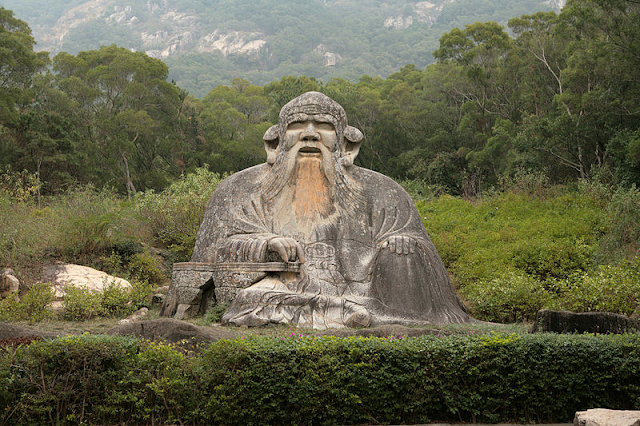
                   Statue of Lao Tzu (credit: Tom@HK, via Wikimedia Commons)


The Tao Te Ching says: “The Tao that can be spoken is not the Tao.” Lao Tsu was telling his disciples never to feel confident that they had life figured out or feel complacent about their capacity to handle its challenges. Complacency is the harbinger of disaster. The way of all ways, the Tao, is always shifting. To live as individuals, but far more importantly as nations, we must watch our surroundings, stay alert, resourceful, nimble, and sharp while remaining true to our largest values, the ones that we can see match the most general constants in reality. Then, when we must act, we are ready.  


Our most general basic values are not tied to how we fish or cut our hair or talk or dress or make bread. They are far more pervasive and general than that. But they are found in all cultures in varying degrees, combinations, and styles because they work. They are our tested, tried, and true best guides to where the shifting path of long-term survival lies. Our basic values will apply even on a planet to which we must bring our water because the planet is so dry.  


So what do all these analogies between the biological and cultural modes of evolution tell us? Non-human species are programmed mostly by their genes to behave in ways that are well-suited to life in their environments. Species adjust to changes in their environments, mostly, by testing variations of their gene codes in the physical world and keeping the variations that work. Evolution.


Human tribes, on the other hand, survive and adapt almost entirely by cultural variation and testing. This chapter’s analogy between genetic evolution and cultural evolution helps us to understand cultural evolution more deeply because the cultural mode of evolution mirrors the genetic one in many ways. 


And to close this chapter, I need also to underline the most important way in which memes can be compared to genes and social species to biological species.


A society is an ecosystem. It can contain millions of individuals and hundreds of “social species”, sub-cultures which sometimes cooperate and sometimes compete and switch from one role to the other even with the same neighbors, as evolution advances. Entrepreneurs. Doctors, lawyers, and engineers. Artists. Farmers. Tradesmen. Academics. Soldiers. These and many others can be seen as “species” within the social ecosystem. To those who seek a rigid, prescriptive set of beliefs and morés for all members of their tribe to live by, I will repeat that such thinking is, in the first place, a vestige of tribalism that we can no longer tolerate. In the past, it set tribe against tribe. Out of the wars that ensued, yes, our species got stronger. But today, either that way is done, or we are. By pushing us to invent and build deadlier and deadlier weapons, war has made itself obsolete. Our climate problems also have become planet threatening. Thus, either, we take over our own evolution or we die. It’s that simple.


In the second place, rigid, prescriptive thinking just is not consistent with what we know from Biology about how ecosystems work. A society, like any living ecosystem, to stay healthy, does better and better the more diversity it contains. Then, it can adjust its internal balances and interactions in many different ways, and adapt to changes in its environment, and still remain stable and vigorous. As biodiversity is good for an ecosystem, cultural diversity is good for a human society, as long as citizens do not let themselves break into mutually hostile factions. Which means, as long as they love each other, they will discover or devise ways to make their social ecosystem work. This is the purpose for which our species evolved the intelligence we now have. We are designed by evolution to take over managing evolution: the evolution of our species, our fellow species, and the biosphere of Earth. Then, to carry this incredible miracle – life – to the stars.


Tolerance and diversity are the most telling hallmarks of freedom. Thus, at least some anxiety comes with being human, especially in the most vigorous of societies – namely democracies. We are genetically hard-wired to feel nervous when we encounter other humans who look, talk, and act different from the ways we grew up with. That is why war comes so easily to us.


But we can also reprogram ourselves. That too comes with being human.


Reason is the gift of our recent evolution, and it tells us that social diversity is good for us in the long haul. We can see that truth in the evidence of our own history. So? We must teach the kids to get used to pluralism and the occasional nervousness that comes with it.


And to the depths of your soul, dear reader, know this: it is just smart to respect your neighbor’s “ways”, even the ones that you find strange. In this real, uncertain, physical world, your neighbor’s “ways” may one day save your life.


Notes


1. “Convergent Evolution,” Wikipedia, the Free Encyclopedia. Accessed April 30, 2015.http://en.wikipedia.org/wiki/Convergent_evolution.


2. Richard Dawkins, “Selfish Genes and Selfish Memes,” in Douglas R. Hofstadter and Daniel C. Dennett, The Mind’s I: Fantasies and Reflections on Self and Soul (New York, NY: Basic Books, 1981), pp. 123–144.


3. Alasdair MacIntyre, After Virtue (London, UK: Bloomsbury Academic, 2013), p. 78.

Monday, 5 July 2021


                                     Chapter 18.                 (continued) 


This discussion of the ways in which social/cultural evolution can be compared to genetic evolution can be fruitfully pursued even further. We can provide more evidence that the analogy between memes and genes is not a metaphor. Meme variation and selection drive cultural evolution as surely as genetic variation and selection drive other species’ evolution in the biosphere. 


Another comparison between a meme that is found in many cultures and a set of genetically programmed features in several species of the living world will deepen our understanding of how cultural evolution works.


                                                  Prickly pear cactus, USA

                                (credit: mark byzewski, via Wikimedia Commons


     Cactus flowers, Jordan (credit: Freedom's Falcon, via Wikimedia Commons)


In Biology, convergence is the term for the phenomenon seen in species that are separated geographically, but that, after eons of evolution, are using similar strategies for survival in similar habitats. Desert plants of widely differing species, in widely separated deserts, all have waxy leaves. They also delay reproducing – maybe, for years – until that rare desert rain arrives.


                                    Native elder Agnes Pilgrim and grandchild

                                            (credit: José Murilo, via Wikimedia)


Similarly, nearly all human societies that have made it into the present age – with vastly disparate cultures and from widespread geographic areas – respect, value, and heed their elderly. Why? Because in pre-literate tribes, an old person was a walking encyclopedia of the tribe’s knowledge – of hunts, plants, diseases, etc.. What the old had stored in their heads could save lives, even save a whole tribe. Thus, honoring one’s father and mother became a value in tribes all over the world. Tribes that honored the elders grew and thrived. Ones that didn’t …didn’t. This evidence demonstrates convergence in the cultural realm.


             Indonesian and grandson (Uwe Aranas, via Wikimedia Commons)


For even more general reasons, wisdom is a core value in cultures everywhere, so common that it’s seen as basic to human life. But I stress again that this meme is not put into us by genes. Respect for wisdom is socially programmed.


The wisest lion in a pride is not necessarily its alpha leader. That position goes to the strongest, and the wisest old cat can readily be pushed aside by a strong young challenger. Humans, in their societies, have learned a better way.


There is nothing in the genes of the human animal to predict that valuing wisdom will occur in societies everywhere, as naturally as walking on two feet does. Bipedal motion arises automatically out of our genetic design. But values like, for example, respecting elders don’t. Certain values are found in societies all over the world because they work; they’ve proven over generations that they make a human society more likely to survive and flourish. This is convergence in social evolution. Our societies are analogues of cacti with waxy leaves. However, societies pass on the value that teaches the young to respect the wisdom/experience of their elders by cultural means rather than genetic ones.


 Graphic of fitness landscape concept (Randy Olson, Wikimedia Commons)


Other concepts from Biology also apply to cultural evolution. One of the subtlest is what evolutionary biologists call a fitness landscape, which is the model from which the concept of cultural convergence derives.1 If we draw a graph showing how two genetic traits, say size and coloring, interact to give a size-color survival index for a given species in a given environment, we can find the place on the graph where the two traits hit the spot that yields the best overall survival odds for that species in that environment. 


Next, we can plot a similar graph for three biological traits of a species in three dimensions, with an x axis, a y axis, and a z axis. The resulting picture would show in three dimensions a theoretical landscape with ridges, peaks and valleys. The peaks indicate where the best combination of coloring, size, and, let’s say, coat density lie for that species’ survival in its environment.


Geneticists speak of fitness landscapes of ten, fifty, and two hundred dimensions as if what they are talking about is completely clear. No graph of any such landscape could be pictured by the human mind, but with the mathematical models we have now, and with computers to do the calculations, geneticists can predict which niches in an emerging environment will contain which kinds of species and how long it will take for species in that ecosystem to find balance.


The concept of a fitness landscape – one that exists only in mathematical space – can then be applied to the combinations of memes in human cultures, combinations that produce morés and patterns of behavior in real people’s lives. The concept of a meme – a basic unit of human thinking – is a tenuous one, and it is still considered by some social scientists to be unproven and of uncertain value. (see Dawkins’s “Selfish Genes and Selfish Memes,” in Hofstadter and Dennett’s The Mind’s I for a basic explanation of the meme concept.2) But for now, because we must build a new moral code, we shall take the meme concept as a given, in order to see where it leads us.


We can construct, in imaginary, mathematical space, a fitness landscape for memes – for basic concepts, in other words – that humans use to build systems of beliefs about what the universe is made of and what forces drive and steer the movements of the things in it, including us, the human, thinking things.


That fitness landscape, that multi-dimensional graph of the ways of thinking underlying a culture, will be very similar for all individuals in that culture. I tend to reason my way to the same patterns of behavior as my parents lived by. What I mean by words like red and round, sweet and edible is very close to what other English speakers mean by these terms. So is what I mean by plum and apple. I recognize the things these words name. I like fruit. I eat it often. 


My ideas of beauty also roughly coincide with other Canadians’ ideas of beauty. Even our definitions of abstract terms like goodwisejust, and democracy roughly coincide. They enable us to communicate (at least within and between sub-cultures which generally tolerate each other), work in teams, and live in communities. Mostly fairly successfully, in fact. I am a son of my culture.


Useful concepts – that is, meme combinations that correspond to peaks on the fitness landscape – are “found” by the people in a culture over generations of that culture’s evolution because through trial and error, the concepts prove effective in physical reality. They enable people who think with them to design behavior patterns that get good results, and so, to survive and flourish.


No single culture is ever the only combination of concepts or behavior patterns that could work in a given environment. People of other cultures could use their own concepts and morés to survive there. Human societies are varied, tough, capable, and versatile, similar to the various species in a living ecosystem.


But any society or tribe that settles in a given ecosystem will come to think with at least some very general memes, concepts, and values that enable the tribe to survive. For example, people can learn to fish with hooks, nets, spears, or baskets, depending on what materials are available in their region and what technologies are already familiar to the people. But the odds are high that if there are lots of fish in a lake, then any tribe that settles next to it will learn to fish, by one method or another.


           Stilts fishermen, Sri Lanka    (Bernard Gagnon, Wikimedia Commons)


    Traditional fish trap fishing, Vietnam (Petr Ruzicka, Wikimedia Commons)


             Ice fishing, Canada (credit: mattcatpurple, via Wikimedia Commons)


                Bow fishing, Philippines  (James David Givens, Wikimedia Commons)  


People in varied cultures all over the world also establish markets in their towns for commercial activities like the selling of vegetables and fish, and they hire police to patrol the market to stop thieves. Getting fish out of the water and into human stomachs is healthy for tribes that learn to catch fish and set up markets. They get stronger and out-multiply less vigorous neighboring tribes. 


Marketplaces, policing, and currencies are efficient social constructs because they help societies that create them to maximize the usefulness of what their citizens produce; they allow venture capital to form and flow. If the people have no currency yet, even a commodity (like gold) can work as currency and so as venture capital that can then flow, in a timely way, to where it can do the most good. Fresh fish are a healthy source of protein. Rotten fish benefit no one’s diet. Hence, marketplaces. We can’t eat gold, but it can serve as a currency. 


Some large meme complexes we call values guide us toward forming institutions that are advantageous for the tribe and especially for the subgroups that believe most devoutly in those values. Some do not. Values survive if they enable people who follow them to create behavior patterns that work, behaviors that feed and shelter more people, and enable them to live, work, and reproduce together in peace. The tribes that believe in and practice these values survive in greater numbers over the long haul of generations to pass the values on to their young.


              Learning a custom: Maori warrior hongi-greeting American soldier

  (credit: U.S. Air Force photo/Sgt. Shane A. Cuomo, via Wikimedia Commons)


                               A custom: traditional Indian Namaste greeting

                         (credit: Saptarshi Biswas, via Wikimedia Commons)