Saturday, 20 July 2024

A Defense of Moral Realism: Introduction 
Part 1 

 Science is our hope and yes, I really believe that 


                                                                                 Svend Hansen 
                                teacher, principal, school board member,                                             
                                        Edmonton, Alberta  

                            (credit: Edmonton Public Schools) 


In grade 9, I had a really good Science teacher. He loved Science, he loved kids, and he loved getting the two together, which is all a good teacher really ever has to do. On a cool fall day in Edmonton in 1963, he taught my Science 9 class a basic lesson: the scientific method – what it says, how it works, and why it gets the amazing results that it does. I’m sure that I have embellished the picture in the years since that day, but basically, I recall clearly that on that day I got the scientific method, which is to say I understood it, and it filled me with hope.

I saw that prior to the arrival of science in my society, when people had had a question about some events in their lives – a question for which they had no stock answers – they had consulted wise women and men who were supposed to be able to give them answers. But often the answer was: “Because the gods decreed it that way. Our lot in life is to accept their decrees, not question them.”  In fact, people generally believed that the profound truths of the universe were beyond reason and evidence, too complex for almost any humans to grasp.

They believed a few special people could see those truths by revelation, a rare state of mind that was a gift that could not be attained by reason or discipline.

Lesser truths – about how to deliver babies or keep goats healthy or similar practical matters – could come to some minds via years of apprenticeship under a master of midwifery or goat husbandry or whatever. But even the masters’ knowledge had come via masters of previous generations. In other words, most of the tribe’s knowledge was passed down like habits – older people training younger ones in the knowledge and skills that the tribe had accumulated slowly over generations, mostly by trial and error, not reason and not revelation.  

Without revelation, humans could grasp only these lesser truths. What right and wrong are and why the cosmos exist weren’t matters for ordinary folk to understand. Instead, those things were learned as dogma and accepted without logical explanation or question. Some of each tribe’s knowledge was justified by something like science – by reasoning and evidence, in other words – but much more was justified by religious belief, with many ideas justified by bits of both. All of these then made up the total conscious wisdom of the tribe.

And many of every tribe’s ways weren’t conscious and weren’t justified at all; they were customs so ingrained that no one raised in the tribe noticed them.

Each tribe accumulated knowledge gradually over generations, and even then, a tribe’s total stock of knowledge was small when compared to its ignorance.

The scientific method changes this picture. With the scientific method – what Bacon called the “Novum Organum” – people could go beyond explanations like “we’ve always done it that way” or “the gods decreed it that way.” People could choose to respond to a problem that they wanted to solve by first, studying it closely, then forming a hypothesis about why it was the way it was, i.e., an explanation based on reasoning and evidence and pointing to possible causes and effects for why events might be unfolding in the ways that they did.

Then, if I were the seeker of understanding in this picture, I could imagine an experiment by which I could test to see whether my hypothesis worked: that is, I could imagine future circumstances in which – if my explanation of what was going on was correct – I’d be able to predict what was going to happen next. Most of the time, most hypotheses turned out to be wrong. But the seekers kept trying, and once in a while they hit on a bit of knowledge that was amazingly useful. They found a new way of looking at the world that worked so well that it gave them new power to direct the events of their lives.

How to make fire or how to make wheels were ideas of this breakthrough type, but we’ll probably never know who first had those ideas. On the other hand, we’re fairly certain it was Archimedes, a Greek scientist who lived and worked over 2200 years ago, who figured out how things can float in water. Anything wholly or partly immersed in a liquid will be buoyed up by a force equal to the weight of the liquid that it displaces. If the water displaced weighs more than the thing being immersed, the thing will float. This was a very useful insight because it enabled people who built ships to design the hulls of those ships with great skill. By doing more testing, Greek shipbuilders learned to make fast, efficient warships and cargo ships. Then, shipbuilding became very profitable in Ancient Greece.

It is useful to note here that any hypothesis that can’t be tested in this physically observable way is not science. Science has no interest in untestable hypotheses.  

Note that future circumstances about which I am making my prediction might be ones I can set up at will. For example, if I hypothesize that using a longer lever will increase the load that I can move, then when I get a longer lever under this boulder I’m straining to remove from my field, I should be able to move that boulder with the same force I had applied to my end of the first lever that didn’t work just a few minutes ago.

Similarly, if I have by coincidence found a new chemical substance that I think will kill coddling moths, I can spray it into an enclosed chamber of a few cubic meters of air set up in my lab, one in which I have already trapped a dozen or so adult coddling moths crawling about on a small apple tree. If all the coddling moths die in the space of a few hours, then I will be able to conclude, tentatively, that I have found a new pesticide which kills coddling moths.

But it is also worth noting here that there are some hypotheses for which I can’t set up test conditions. Hypotheses in astronomy are clear examples of ones that I can’t test in a lab whenever I want to. I can’t summon up a comet anytime I please; I can’t check at will whether comets reflect more blue light than yellow light. But comets large enough for me to study through my telescope do pass by the earth every few years. I can test my hypothesis if I just show a little patience and wait for the next one.

In either case, when the phenomenon that I am interested in happens, if I am a serious scientist, I will observe changes to the physical properties of the things I am studying. I will carefully record all of my observations or data, and after the events I’m watching are done, I will study my data to see whether the outcome that I predicted would happen, did in fact happen as I said it would.

Sometimes, the prediction comes true in obvious ways, as when the coddling moths in the chamber all die. Whether the pesticide I’ve found is safe for other species is another question, but these moths are dead. With the longer lever, I can move the stone I could not move before. Hypotheses can be confirmed.  

Sometimes the predictions made by scientists doing the experiment come true visibly, even dramatically. But often in our era, the results of research are only observable via instruments (microscopes, telescopes, etc.), and even then, only over very long or very short timespans. Scientists today often use instruments to cause a change to happen, then use more instruments to record data as they happen. They save the recorded data and study them, and do calculations with them, after the experiment is done.

Let’s reiterate that in all cases – ones of large phenomenon or very tiny ones, very fast or very slow ones – in order for a hypothesis to be considered scientific, it must be observably testable. The experiment is set up so that the observations will clearly either confirm or disconfirm the hypothesis. I’ll see the results I predicted either clearly happen or clearly fail to happen.

Often, what we find out is that we ought to be trying to steer nature with much more care and nuance than we have been doing. For example, my moth-killing pesticide may also cause birds in my area to die; this may allow other pests to breed rampantly. Meanwhile, by more experiments I may learn that there are other species in the orchard that control coddling moths without upsetting the natural balances there.

Today, everything we know about nature is leading us to the conclusion that we can affect natural balances, but we must learn to do so carefully if we don’t want to cause side-effects that will be unpleasant for us. Thus, instead of using a pesticide, I may choose to breed predator species that eat coddling moth eggs. Then, if I release large numbers of these predators into my orchard, I may be able to wipe out coddling moths in my whole area. And no toxic chemicals will need to go into the orchard at all.

It is also useful to say here that most humans are hypothesis-makers. We like to try to figure things out, imagine possible explanations for events happening around us. We have curious minds.

What a mind is exactly can be hard to define. So I am going to postulate for the purposes of this essay that all living things have at least a primitive mind. I say this because research is telling us that even protozoa like amoeba can learn new rules and change their behaviors when their worlds change. Thus, I am going to describe, not define, what a mind is by saying it is a trait possessed by any organism that is able to recognize patterns in events and then come to avoid those events that will cause it damage or to pursue ones that hold opportunity.

All living things can do this. How exactly they do – how living things learn and know – we so far can’t characterize in simpler terms. But we see their actions.

But why should we have to give simpler definitions? All realms of knowledge begin from definitions of a few basic terms that are considered self-evident and necessary if that field of knowledge is to be explained. Terms like “point” or “line” in Geometry; “mass” and “force” in Physics. Etc.

So let’s propose for this essay’s sake that mind is a quality any entity has if it can learn from experience to change its ways of behaving so as to avoid hazards and pursue opportunities relevant to its own well-being. 

What the scientific method did for our more curious ancestors – when they kept it in mind – is that it gave them a systematic series of steps to follow, steps that would lead them to more and more models and theories that worked better and better for predicting results of recognized patterns in events. Such models then enabled them to steer events in nature or steer around them and, consequently, to live healthier, safer, more satisfying lives.

The overall conclusion to be drawn from this discussion of the scientific method, however, is that it offers us a path toward better and better understanding of the things in our universe. I got that at thirteen years old. I could see, via many examples, that the scientific method works. It gives us more and more control over nature, and thus, over our lives.

For all of my years since that day, I have believed that, given some time, science can solve every problem we humans encounter. Sometimes, it does not give us exact laws that enable us to make exact predictions. Instead, in many fields, a new theory only gives statistical laws that may be used to predict the odds of some event occurring. But statistical laws are still science, not superstition.  

For example, a theory of how hurricanes occur won’t enable scientists to stop a hurricane from making landfall or even say how many there will be in the next three months. But once a hurricane is developing in the open ocean, the theory may enable the scientists to say, day by day, that the odds that a hurricane will hit the coast are growing to near certainty. They can even predict where it will hit a day before it does so. Then, people can be warned to get out of its way.

No cancer research can yet say for sure which of us will get cancer, but research can tell us that our odds of getting cancer drop by over half if we quit smoking.  

In addition, note that if testing shows a theory sometimes leads us to predictions that don’t work, the next step is not to halt research on that theory. The next step is to test the theory further by experiments designed to reveal why it is only working some of the time. Scientific testing – if it truly fits the term “scientific” – always points the way to more and better science.

Science is not now and never will be complete. It’s always telling us to think and test more precisely. Form new models and theories; test them in subtler ways. We’re never done with any problem in science, but our theories and our ways of testing them get more and more nuanced and focused.

Thus, at 13, I found a love for science. Thank you, Mister Hansen. You may be long gone, but you gave me a gift that has put wonder in me to this day. 


            Francis Bacon, father of the scientific method

                           (credit: Wikipedia)       


Tuesday, 9 April 2024


                                                      Benjamin Netanyahu 

                              (credit: Arbeitsbesuch Israel via Wikimedia Commons) 


Historical Traffic

The movie “Traffic” is one of the most interesting films ever made. It told two stories, woven into one another, showing two perspectives on the war on drugs. One story is about a teenaged girl in the U.S. in the 90s, who is the daughter of a judge. The judge, at the beginning of the story, is a hardliner, on the bench and in his life away from court. A disciple of the Reagans’ “just say no” doctrine.

The second story follows a kingpin of the drug cartels, and his beautiful, shrewd wife. Along the way, we see other players: Drug Enforcement Administration agents and a disillusioned Mexican cop, who sees all sides of the drug trade and its consequences, but still keeps trying to bring some order and decency to his job and his world. A decent guy in a corrupt place and time.

The story stuck in my head. It was brilliant because all the ingredients of a good film were there – story, directing, acting, editing – all of it, but more important was the fact that it taught me something profound. In the end, the judge and his wife get humbled by the struggle of their daughter with her addiction. She’s still their little girl, bright and lovable, but – oh, my – how all their lives change. Lost weekends. Near brushes with death. Rehab. The judge, at a group therapy session near the end of the film, says to the facilitator, that he and his wife are “just here to listen”. The mighty get brought low, but along the way they become human.

In the meantime, in the larger drug war ravaging both sides of the border, one gang wins, another loses – for the time being – and the DEA get used. They are pawns in the cartels’ game.

And the Mexican cop? He has to watch his partner get murdered in front of his face. Along the way, he does get a small consolation: he manages to wrangle out of one of the ugly deals he is forced into, some electricity for his town so that the kids there can play baseball in the evenings, and maybe stay out of gang life.

Another personal, human touch.

In the overall view, lies, murder, and greed are all there on every side. And the plot is so convoluted that audiences are left wondering what happened.

It hit me clearly at the end that I would be days sorting this story out, but a few things were for sure: the demand for coke in the U.S. is bottomless; the majority of the people of Mexico are victims, not beneficiaries of the U.S. suburbs’ joy of coke; and the DEA guys in their meetings and machinations, most of the time, haven’t a clue what’s really going on.

But why? Why are American laws and enforcement efforts so futile so much of the time? I thought I saw it in the face of the Mexican policeman played by Benicio del Toro. He knows what has happened. The DEA got outwitted and manipulated by the Juarez cartel. The U.S. cops got played. The ultimate reason for that is that they grossly underestimated their adversaries. Always, a bad flaw to suffer from. They didn’t get that Mexicans could be just as smart as they are. And, for me, that is the story’s point.

What does all of this have to do with now? Just this: a parallel situation is, in my opinion, developing in the Middle East. Parallel?! Yes. Look at it.

What got the Jews of Europe into a position of power at the end of WWII was not the Rothschilds’ wealth or the Elders of Zion or any such nonsense. What gave them the strength that they’re squandering like found money now was a wave of world opinion. The nations forming the UN felt real sympathy for the Jews as the truth about the Nazi camps began to come out. After the war, an unbelievable figure. Six million people. The evidence, the documents, and the witnesses were all there. Six million. And that could very well be a low estimate. How could such a thing happen? Those poor people! They had world sympathy. They parlayed it into a land of their own. They’re losing that sympathy now.

And the Arabs? Too many in the West forget that their culture is also thousands of years old. They can be just as skillful as any other players out there at what is called “The Great Game”. Money, politics, diplomacy. Power. War. “War is the continuation of politics by other means.” (von Clausewitz)

Hamas leaders had seen demonstrated before their eyes for three generations that they’d never match the Israelis in high-tech weapons. They were as brave as the Israelis. But the Palestinian leaders learned the hard way that courage is not enough. In the global picture, over the long haul of centuries, what changes outcomes is having the support of powerful allies. World opinion. Bibi has lost it now. Maybe past all recovery. One shaky ally left. If the next U.S. president says, “Enough is enough!!” (DT would love to say that.), what then? The loss of all world support? Maybe even for centuries?

So what does a film about drug cartels have to do with today’s politics? Nothing and everything. The Israelis are being played now. Hamas leaders foresaw this endgame. They have one asset, and they are using it. They have thousands of people who are willing to die for a cause. A laughable way to try to win a war, you say? Not if you play the long game. It has worked before, and we don’t have to look far to find an example. Bibi is being played. He’s easy to manipulate. He thinks all Palestinians are idiots. His idea of the long game is staying out of jail.  

But you have a nice day, anyway. This stuff all involves people who have been killing one another for millennia, and it’s all far away. It can’t happen here.


                                                      actor Benicio del Toro 

                                    (credit: Gage Skidmore, via Wikimedia Commons)

Sunday, 10 December 2023


                                                                   African Jesus  

                            (credit: Virginia Benedicte; public domain) 


                                           A Hopeful Christmas


Good day. Thank you for dropping by. I have one small announcement: the Chamber of Commerce has asked me to remind you that there are only a few shopping days left till Christmas. Just kidding. I enjoy Christmas shopping like I enjoy drinking bleach.        

        But it’s the meaning of this season, Christmas, that I want to write about today. And I promise to be more serious for the rest of this post.  

What conclusions do we come to if we apply a moral realist view to the cultural phenomenon called “Christmas”? What do I see in the beliefs and customs that surround this man who probably lived from about 4 B.C. to about 33 A.D.? What are we celebrating? What did he stand for? I think more deeply about this question at Christmas time, as most of us do. 

Like many thinkers in Western culture, I get fed up with how commercial Christmas has become. 

The ads sometimes start before Remembrance Day. I find that very hard to take. The men and women who fought in the wars that the nations of the world got drawn into in the last century or so deserve a special time that is set aside just for them. November 11 is supposed to be that day. The rest of us ought to set aside time for them, showing respect and gratitude. Greedy merchants crowding into that time by advertising their Christmas junk infuriate me. I make a quiet vow when I see Christmas ads anytime from Nov. 1 to Nov. 12 to be sure that I do not buy whatever it is those ads are trying to sell – ever again. And in general, we give and receive too much stuff that we don’t need or even like. (“Hello, Little Gift. How long till you’re in the landfill?”)

I don’t like the commercialism that has poisoned Christmas, but I add to that, gluttony and drunkenness. We eat too much food and drink too many kinds of alcohol that we also don’t need or even like.


        Landfill dump (credit: Cezary, via Wikimedia Commons) 


Can anything save me from total disillusionment during the Christmas season? Yes. I couldn’t have said that for many years, but I can today. Ten years or so ago, I figured something out.  

The way of humans on this world for the most part has been to take as much as they can as often and fast as they can. In our era, the philosophy of greed has even begun to threaten what once was taken for granted, namely the ecosystem of this planet. Perhaps in what I have to say today, I can give some hope to those of you who are beginning to despair at the indifference of our leaders toward environmental issues. But my focus will not be on environmental issues because they weren’t issues in Jesus’ time. His main gift to the human race was something else.

The worst consequence of human greed for many centuries of our history on this planet has been the biggest crime, the one that we do to each other. War. When earthquakes or hurricanes hit another land, we grieve for the people there, we send help, and we do what we can. But basically, we can handle natural disasters. The horrors people do to each other are in a different category altogether. A child can tell you that we have more than enough resources on this planet to feed, clothe, and shelter everyone in comfort. Our leaders’ sending us to war is not about making sure that people have enough to live in dignity. Wars are about vain people gaining face. Realizing that fact is what makes us feel so disillusioned with our own species, especially during the Christmas season of "peace on earth, goodwill to men".  

And let me not mince words here. Historians estimate that of the horrors that have happened to people because of the aggression of other people, more than ninety percent have been caused by governments, not by criminals. Wars and genocides. 

Mafia thugs are disgusting human beings, but they are small fry compared to the Hitlers and Stalins of the world. The Shakas, the Genghis Khans, the Caesars, the Alexanders, the Pol Pots, and the Joshuas. The war madness has infected every culture on earth.

Where, then, does Jesus fit in?

War had been ugly and pointless for centuries before Jesus ever came on the scene. Everything any war ever accomplished could have been accomplished without any bloodshed at all, if the people involved had agreed to debate the issues openly, negotiate, and compromise. He saw that. He also saw that the war technologies were improving all the time. Even in 30 A.D., he could see that humanity was on a path of improving weapons till it ended in disaster. Humans appeared to him, even then, to be headed for self-destruction.

The ways of greed, politics, and war and the improvements in our military technologies can be represented by lines on a graph of time. As the two lines climb forward across the graph – as our greed and our technology both keep growing - we watch in horror. We know that inevitably one day the lines will touch. There we will finally make a weapon capable of wiping out the whole human race at the same time as the sea of politics casts up a leader who will use it. There is a kind of paralyzing, mathematical certainty to this graph. Even to Jesus, two thousand years ago, it looked as if we were doomed to someday destroy ourselves. Bigger and bigger weapons, more and more greed. He saw this desperate situation taking shape even in his own time.

But he saw further, and he put into his own time a new way of seeing ourselves. A new worldview. He left us this: love one another as I have loved you. If you remember nothing else that I told you, remember this: love one another as I have loved you. You can do this. You really can. Just love your neighbor. Then all the good you can imagine will follow.  

In the middle of the Roman Empire, Jesus’ time was a time when war and the ways of life that it forced people into were considered obvious. Almost every person in that empire would have thought debating the matter was childish. If you had begun to argue that war might not be necessary, they would have told you, “Oh, grow up!” Most would have looked at you like you had just grown donkey ears. The main thing they all prayed to their gods for was victory in battle.

All the recently conquered peoples in the Roman Empire in Jesus' day contained rebels who were eager to get even with the Roman conquerors. This was especially true of the Jews, the people among whom Jesus had been born and grown to manhood. They had many secret groups plotting sabotage and assassination all the time. 

In this social milieu of jealousy, hate, and violence, people paid to go to arenas all over the Empire and watch men kill each other, right there in front of their eyes. Bloody corpses dragged away at the end. Their worldview was built on the assumption of violence.  

Then Jesus came along and said: “It doesn’t have to be this way. If a man hits you on one cheek, turn the other to him. If he grabs your jacket, give him your shirt. If he forces you to walk a mile with him, walk three.” And he lived his values, all the way to his death. Others had said similar things, but Jesus, by the actions of his life and by the dramatic character of his death, caused people to listen and remember.

Beside that message, everything else he said and everything else that was ever said about him pales to insignificance. 

Since those times, heroes all through history, even modern ones like Gandhi, Mandela, and King, have shown by real-world example that with enough courage, the way of non-violence really can work. Christians have mostly been less sincere in observing Jesus’ simple rule, but they have still gotten gradually kinder every century since Roman times. The horrible “games” of Jesus’ time were abolished in about 300 A.D.. In more modern times, no one goes to bear-baiting anymore, as they did 400 years ago, and people who secretly attend dog fights, once their secret is discovered, are hounded from our midst and quarantined in jails, as unfit to live with. Even then, if they ask sincerely for forgiveness, they can still be forgiven. Jesus gave us that too.

At first, the Romans didn’t consider Jesus’ ideas important. In fact, they thought his ideas were stupid. But well after he was gone, his cult – and a “cult” is what it was to the Romans – kept growing, in spite of hard efforts on the Romans' part to stamp it out. There was something about it that tugged at human emotions. Worst of all, it began to steal some of the sons and daughters of citizens all over the empire, even right in Rome. Many of these converts were teenagers, fed-up with the materialistic, hedonistic emptiness of their parents’ way of life.

The Roman Empire is long gone, as are many other empires. Too many to list. Jesus’ words are still here. Love your neighbor.            

So, for me, was he divine? Was he the son of God that the churches claim he was? No, not to me. Or to be exact, he simply had a lot more of a quality that all of us have, the spiritual quality, the capacity to believe in, and live by, things not seen.

But what matters much more is that he put into the mix of ideas being passed back and forth by the human race, the simple idea that we can solve our differences without killing one another. Thus, he injected a new variable into the equations of human history. If we can learn to love our neighbors, we may make it through the era of greed and war and finally grow up. Emerge as a new, sensible species, a differently programmed species that no longer needs to keep itself fit by programming its young to be their own predators. In short, maybe, we can stop trying to toughen ourselves by war. We can find another way. Learn to keep ourselves strong by individual hard work and self-discipline instead of by killing one another. 

Before him, our destroying ourselves was a mathematical certainty. Then, he inserted a little ‘maybe’. Maybe, we really can learn to love our neighbors.

For me, seeing the truth of that one big principle is more than enough to keep me from cynicism at Christmas time. Christmas, for me, is the time of year when I celebrate the fact that this gentle man entered into the flow of human history in the most warlike society that, up to his time, had ever existed, and changed – everything. He showed us a different way, and he gave us hope. 

So what if some lying, greedy politicians won this latest round of elections? My struggle against them will go on. They can’t stop that as long as there is breath in my body. I have free will and a truth to live by. The rest is up to me.  

Let materialism and greed fill the shopping malls to the roofs with glittering plastic junk. They can’t discourage me. I believe in something real that is beyond all of that. 

We keep trying. We win some and we lose some. The struggle goes on. But there’s hope now. Before this one guy, as I see human history, anyway, there was none.

Merry Christmas, lads and lassies. Enjoy your families and friends.


                                          Nelson Mandela at 19 

                                            (credit: Wikipedia) 


Quote by Marianne Williamson (often used by Nelson Mandela):

Our deepest fear is not that we are inadequate. Our deepest fear is that we are powerful beyond measure. It is our light, not our darkness, that most frightens us. We ask ourselves, who am I to be brilliant or talented? Actually, who are you not to be? Your playing small doesn't serve the world. There's nothing enlightened about shrinking so that other people won't feel insecure around you. We are all meant to shine, as children do. We were born to make manifest the spiritual glory that is within us. It's not just in some of us; it's in everyone. As we let our own light shine, we unconsciously give other people permission to do the same. As we are liberated from our own fear, our very presence liberates others.

Wednesday, 22 November 2023


                                 Kennedy's car just after the fatal shot 

                        (credit: Abraham Zapruder, via Wikimedia Commons) 


A Thoughtful Day

Today is a deeply thoughtful day for anyone over 65, almost anywhere on earth. Why do I say so?

On this day sixty years ago, American president John Kennedy was shot dead.

For younger followers of this space, you might consider where you were, whom you were with, and what you were doing on September 11, 2001. That day is called a “landmark” day because everyone over 25 can answer those questions. That day changed everything. But for those of us who are a bit older, November 22, 1963, changed the world even more.

He was only one guy. His supposed assassin, Lee Harvey Oswald, was shot and killed in the basement of the Dallas Police Department two days later. The guy who shot Oswald was a long-time Mafia associate who was dying of cancer. In a metaphor then, I’ll say the whole event stunk like old fish guts. It still stinks. Too many people who were there were certain one of the shots – probably the fatal one – came from in front of Kennedy’s car. Oswald was positioned way behind it. And there are so many other inconsistencies in the “official” version of what happened that day.

There is film footage of the actual shooting on YouTube if you want to see for yourself. Abraham Zapruder, a citizen of Dallas, was filming the motorcade. He sold his film to the publishers of Time magazine who showed it to the world.

I’m not a conspiracy nut, but I do – like many people all over the world – think there had to be a conspiracy behind those events. If you’re under 65 and you find yourself interested in the controversy, Oliver Stone made a documentary in 2021 on the improbability of the Warren Commission findings. JFK Revisited. It’s on Crave now. The vital scene from Zapruder’s footage is in Stone’s film.   

But why for us old guys was it such a terrible day. Many more died in 9/11. Why does one man’s assassination loom over those who recall?

Because so many good things ended, and so many other bad ones began.

I read a variety of stuff. I’m 74, and no, I’m not senile. Not even a little. I don’t read endlessly about that day or, more generally, about JFK’s life, actions, and words. But, yes, I’ve read about 20 books on that man and that day. Over 60 years, not that many.

Kennedy would have kept the U.S. out of the Vietnam War. I’m as sure of it as one can be about any hypothetical. He was working to do so even then, in 1963. He would have worked more effectively to fix America’s race problem. More than what was later done without him? Yes.

He would have reformed the financial system, likely ended the Federal Reserve.

He would not have gotten “played” for a sucker by the CIA again. The Bay of Pigs fiasco had finished him with trusting that agency. By the time of the Cuban Missile Crisis, he also no longer trusted generals. Too many warmongers among them. He’d seen war. Up close. And he knew the buck stopped with him.

He was in charge by late ‘63, he was learning fast, and he was a decent man.

I could go on and on.

Did we learn anything from it? The US got into a lot of foreign wars after that date and supported a lot of corrupt foreign leaders. The civil rights misery goes on, though it is improving slowly. The financial system is beset by ills every few years. Right wing economists claim they’re full of wisdom when markets are booming. The profits are due to their skills which are far beyond the intelligence of the rest of us. But they hide when markets crash. The few still around say no one could have foreseen this latest crash. Successes are due to clever financiers. Failures are beyond human control. Hypocrisy never troubles greed.

Yes, JFK’s father was maybe the worst stock market manipulator ever. But JFK grew out of his father’s influence before he even got to the White House.

Yes, he was promiscuous. So were Thomas Jefferson, Nelson Mandela, Martin Luther King, etc. The list is nearly endless. Catherine of Russia and Elizabeth I of England were promiscuous if anyone wants to begin false comparisons. Leaders often are. Male, female, good or bad. It has nothing to do with their job.

But he was handsome, funny, and brave. (Read PT 109). And so smart. He might even have brought us world peace. I know I was hoping. Nukes haunted us more in those times. But he and Soviet leader Khruschev had begun to really talk.

And I have to describe the larger context. America bankrolled Japan and most of Europe and many other smaller nations in those days. She forgave her biggest enemies, Germany and Japan, and turned them into friends. What nation in history had ever done that? JFK was all the best parts of America for us then.

I was 14, a smart kid, and a prolific reader so, yes, I really did know all of this.

Doug Cameron lives near the school, close enough to go home for lunch. He is standing in the south-east entrance of Hardisty Junior High, telling a circle of hushed teenagers what’s on the radio and tv.  Then, uproar takes over.

A radio channel is on the p.a. I can barely hear it. Other kids are yelling, crying. I start trying classroom doors. Teachers were supposed to lock their rooms at lunch, but a lab is open. I step in. Walter Cronkite tells me President Kennedy is dead. It’s confirmed. I stand very still as something inside me crashes. Tears begin to roll down my face. For a decent man and his wife and kids and the U.S. to the south of me, but even more, at 14, I know it’s the end of innocence for us. It’s the end of believing that sometimes the good guys can win.

A t.v. personality named Dick Clark probably said it best. Someday, we would laugh again. But we would never be young again. For millions of us, the distrust and despair of the modern world began on that day. JFK is dead.


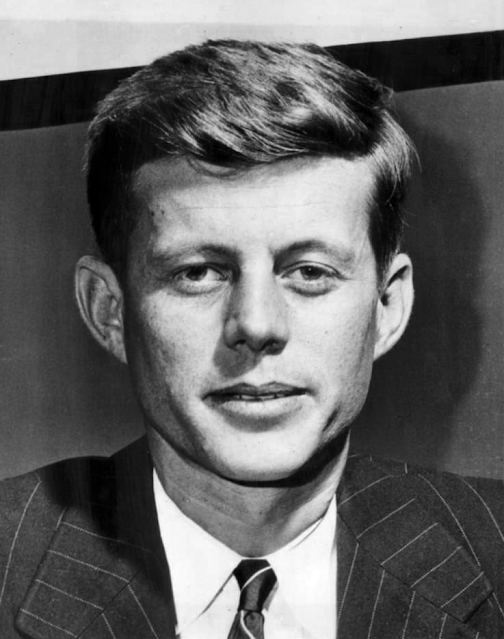
                                          Congressman John F. Kennedy (1947)

                    (credit: US Chamber of Commerce, via Wikimedia Commons)

Sunday, 5 November 2023


                                                      Renee Zellweger

                    (credit: Berlin_Film_Festival_2009, via Wikimedia Commons) 


                                              The Women’s War

I’ve long thought that the idea that all the men of the world should apologize to all the women of the world was silly. I know it was a quote I read somewhere. I can’t find it right now. But I don’t have to look very far to disprove it. I find immoral women in my world, ones who hurt on purpose with no regrets; hurt each other, their men, and their kids. Even become right wing politicians. But there are just as many men as anyone can see. Or some become left wing politicians who learn moral judgement, while unlearning forgiveness.

We are a fallen species, Christianity says. All down here in the mud. And there’s lots of evidence supporting that belief too, for those who wish to promulgate it. But I get weary of the endless recriminations aimed by everyone at everyone. Moral high ground maneuvers. Books on them fill our society. Achieving …what?

For persons of conscience then, is the answer to withdraw from society? Find total humility? Contemplate the mystery of the universe? Meditate hourly? Not for me. I can’t study my navel while my grandchildren’s world goes to ruin.

So I speak up. And as an individual male, not a representative of patriarchy or any other ideology, I sometimes make a mistake and realize I’ve made a mistake and apologize. As one male. Not a representative of any system. Take my lumps. Move on. I keep trying for a life of engagement with my world and its problems because to do otherwise would make me a piece of unwanted tissue in my own eyes. A social skin tag.

So today, I’ll begin from that. And apologize to most of the women of my world.

I repeat that I can’t blanket apologize for patriarchy. I didn’t make it. I work to change it. I want out of it as much as any woman I’ve ever known.

And we do well to remind ourselves that some women don’t. We should never forget Phyllis Schlafly; her adherents number in the millions. They’re out there. Fifty-six percent of white women voters in the U.S. voted for Trump in 2016. I think the explanation is that they grew up in patriarchy. They know how to play its game. They will not let it go easily. The power of cultural conditioning can, as Shakespeare says, shove by justice.

But I do apologize to the women in my life whom I did not properly understand for a long time. Many of them don’t give primacy to the issues of politics and war in their lives. I long believed they should. I see now why they don’t.  

I’ve had circular arguments with some of the women in my life on this subject for a long time. One can’t – I’ve long argued – just ignore politics, and sometimes, the failure of politics which is war. If you don’t deal with war, it will come to deal with you.

But that is not the end of this argument. I thought it was. It’s not.

The brutal truth that old soldiers won’t tell is that they didn’t just see terrible things, they did terrible things. Brutal, horrible things. With their own hands.

But women have hard truths of their own that they don’t want to tell. Especially many of the ones who are still serious contenders in the Make-up Games.

 The women’s main hard truth goes something like this:

“If I and my children and my old mom are driven to the extreme sometime in your hypothetical future …for food and medicine and some temporary security, I’d trade the main thing I have to trade. I know I would. You know what that thing is. And if that hurts your feelings, too bad. When my kids begin to starve, your feelings won’t be on my mind. In fact, that victor with his clean uniform and shiny rifle and full rations pack is going to look pretty good.”

I know now that the women don’t like to say such a truth out loud for a reason similar to the one that silences soldiers who have seen war up close. They don’t want to see the look in your eyes change. The ideal die. 

It's true that some women don’t understand war for what it is. But many do. Older ones who’ve seen its effects on their men, and young ones who are just smart or who have lived by war. Most don’t want to kill anyone. So, if desperate times should come, they know what they would do for the survival of their kids.

In fact, if you want to see what ruthless looks like, kill one of the kids. Wounded American soldiers in Vietnam, lying helpless in a rice paddy, prayed that if they were found by the enemy, that enemy would be male. Then, there’d be a chance that they might be spared. With a female soldier, there was almost none.

Some of this view I learned from two women in my life, and I’ve gradually come to see that it is true, however deflating it may be to male self-esteem. And some of it, I learned from art. Cold Mountain, in particular. It was the defining work of three actors’ careers as far as I’m concerned: Jude Law, Nicole Kidman, and most especially, Renee Zellweger. She was just amazing.

But the point of the film, for me, was left to Kidman’s character, Ada Monroe. In voice over narration, at the end of the film, she says:


What we have lost will never be returned to us. The land will not heal - too much blood. All we can do is learn from the past and make peace with it.


That quote haunts me. The South, whatever its vices, suffered terribly in that war. But the South did go on.

This truth isn’t – as many male novelists in Romantic tones would have it – that the “land” goes on. The land doesn’t care. It’s the moms that go on.


                                                Nicole Kidman 

                                (credit: Georges Biard, via Wikimedia Commons) 

Thursday, 2 November 2023


                                                   Benjamin Netanyahu  

                       (credit: U.S. State Department, via Wikimedia Commons) 


                             Small Town B.C. Characters: Hugh

When I was 14, for two weeks, I visited my aunt who was a nurse in a small, northern British Columbia town. She was a great nurse and she loved me. She never had kids of her own. And I did have fun with some of the neighbor kids.

But the thing I recall most vividly was visiting one of her friends in an even smaller town nearby. About 1963. My aunt talked almost the whole time with her friend. I talked to the woman’s husband who at that time would have been around 45. A truck driver on a local route. Not a long haul driver. Didn’t want to be. Trucking in the mountains in B.C. can be a scary business. What made him interesting to me, however, was when I got him talking about WWII. He’d been and had fought. Over two years. In Italy.

He'd had a few beers, and he had three more while we were there, and he knew he would very likely never see this yappy kid from Alberta again. He loosened up a bit. Or at least that’s what I recall now from that night.

I was – you could say – a nosy kid. I was curious to know how this war that had been so terrible ever got under way. And what did the guys who fought in it think afterward. To be clear, I hated and feared the whole idea of killing another young guy even then. The Vietnam madness had not started to wind up at that point, and even when it did, how many thousand Canadian young men went down to the U.S. to join the American forces is still unclear. (I did know two in later years. But this night was well before the Vietnam time.)

He talked about a few funny incidents in 1943, and he kept opening up a bit more and a bit more right up till we had to leave, at about 11. Near the end of our conversation, I let too much show, I guess. I told him I still didn’t really understand how the WWII madness had got started and most of all, why it had turned so ugly. The memories that he shared with this nosy kid had gotten more and more brutal as the night wore on, though he never actually described the things that he had done with his own hands. I’ve talked in depth to maybe 20 veterans who saw and did real combat over the years; they don’t tell the whole story. They don’t want to see the look in your eyes change. But with 6 or so beers in him, and a kid he had no stake in before him, Hughie got careless.

It's enough for me to say at this point that I realized a scary thing in the last 10 minutes before we left. I still think he was, and still would be, part of a 10% minority, but the truth began to show through.

“Of all the experiences a man can go through in a lifetime, none of them comes even close to being in combat. Every minute is a week when you are out there in the zone and you are trying to kill someone who is trying to kill you. It is such a feeling, such a high. Even the pleasures of your down time are almost as intense because you know, tomorrow you could be dead.”

You see he liked it. Even at 45, he would have gone again if the chance had come up again. Every experience since had been a stupid bore.

I’m paraphrasing his words, but they were pretty close to what I quoted above.

Robert Mitchum says much the same thing in his role as an American general in the mega-production “The Longest Day”. Actually, he says he thinks almost all men who go into combat have some of this madness in them. In fact, he says, until we face what we really are, we aren’t going to even start to solve this madness.

And I admit during the Vietnam days, I almost drove down to Montana and signed up for the U.S. Army. I had bought the Domino Theory. Ah, it was 1969 and I was still a teenager.

What does all of this have to do with my post today? You tell me. 

What do these two men have in common? 


                                                   Ismail Haniyeh 

(credit:   https://commons.wikimedia.org/wiki/File:03-03-2020_Ismail_Haniyeh.jpg  )