Tuesday, 17 October 2017


             Charleville musket 1766 (credit: G. Garitan (Own work), via Wikimedia Commons)


For one more post, I have to deal with the gun violence issue. The psychological roots of the obsession that some people, especially American males, have long had with guns. 

There are lots of theories out there about the psychological roots of some people's fascination with guns. A Freudian one that irks me claims that a gun is a kind of "phallic extension" and that is why guns appeal so primally to some men. 

But the idea that a gun is a "phallic extension" for insecure men, for me, just makes no sense. The link between the image of a gun and that of a phallus is just too tenuous and far-fetched. At that rate, shovels and conductors' batons and so many other objects could be seen as "phallic extensions". Wotan! That theory is founded on about as much evidence as Norse mythology.

On the other hand, I think some models from the science of Comparative Psychology do have things to tell us. One that I find interesting is called the "cichlid effect".  


It has been cited by several major writers. I first learned about this "effect" in 1970. Kate Millett, in a book called "Sexual Politics", discussed the ways in which human sexual relations are analogous to relations in the political world. There are opening moves, proposals that are subtle or not so subtle, counter-proposals, agreements that are spoken - or more often implied - disputes, resolutions, etc. - in politics and in human relationships. Sex as politics is a useful metaphor. 

But the model that she described which fascinated me most came from the research of Nobel Prize-winning biologist, Konrad Lorenz. He studied many animals' patterns of behavior. In several species, but most clearly, in fish called "cichlids", he found that when spawning season came, the males of this species would only attempt to mate with females that were "awed" by the male (his term). In short, a male would not perform sexually with any female who did not act deferential when he approached her. Millett made it clear that she was contemptuous of the idea. I thought it deserved a bit more consideration. 


There is a reproductive advantage for dominant males and submissive females. That is what Lorenz' followers claimed. Under this model, females get more opportunities to reproduce if they "kowtow" or "knuckle under" to a male. And dominant males get most of the females. Genes for these traits get passed on to more offspring more often.

Does this biological imperative drive human sexual behavior? Lorenz and some who came after him claimed that the answer was "Yes". Men want and need to feel superior to a woman before they will approach her in any sexual way. Control makes confidence. That's the theory. 

I, on the other hand, have doubts about the applicability of the model to human beings. But what does the evidence seem to say? 

Would this model explain the gun obsession of a small but scary number males in the U.S.? The need to own guns, to flaunt them, and, in some cases, to use them on other human beings? Do guns give one a sense of control and dominance? In short, has a deep but powerful sexual need caused the spread of gun culture in the U.S.? Does a sexual need underlie gun violence? 


It is generally acknowledged these days that males, especially white Western males, are feeling more and more under threat. The macho role models that they once looked to for direction are more and more becoming socially taboo. Much of what made the dominant place of Western males in their own society has been discredited. Values, works of art, images in advertising and in the media in general - these are all becoming more and more derogatory in tone toward the old images of "real men". Hairy-chested, gun-handling, hard-punching he-men are largely out of fashion. Maybe, modern confusion about what a man is supposed to be has caused some men to feel a need to carry and collect guns in order to get their confidence back. The return of self-confidence comes with the sense of power carrying a gun brings. Or so the "cichlid" explanation would go.  

The weak part of this way of explaining gun violence is that there are millions of exceptions to this model. Most men, in fact. Millions of men don't need a gun to have self-esteem. In fact, they don't feel a need to bully women period. If they are interested in a woman, they recognize that, unless the interest is shown clearly in return, they are probably wasting their time. They move on. She has a right to her preferences. There are plenty of other cichlids in the sea. 

In addition, millions of women now own guns. Millions more, without guns, are assertive, confident beings in their own contexts. And they have no trouble finding eager male partners for sex or company. In fact, millions of men today are attracted to confident, assertive women. 

In short, my reply to those who seek to find instinct-driven motives for some men's collecting guns is simply this: we aren't fish. What makes humans human is their capacity to recognize and rise above their primal programming. We learn about soils and pests so we can grow larger crops. The knowledge isn't gathered and passed on for the sake of curiosity. The same is true of our knowledge of animals, weather, diseases, etc.. And of our most primal breeding imperatives. We modify them and direct and re-direct them so that we can live together in communities and get along. Live. As whole nations capable of teamwork. Then, we multiply and thrive.  

Thus, men and women both learn to do better than fish do, or dogs or apes do. We don't need to yield to obsolete, primitive drives in order to just live. As a matter of fact, mostly we already have learned to live more sensibly. We do better than any other species on this planet because we can think and learn, change our habits and customs and adapt to changing circumstances. 

We are not fish driven by primal forces beyond our understanding. 

So speaking of learning, we have learned by harsh experience over the last few years, that automatic weapons are not legitimate arms for regular civilians to own. Some ordinary citizens like to hunt, but no one hunts deer with a machine gun. That, for sure, is not sportsmanship.  

The need of the community for basic safety clearly outranks the citizens' right to "bear arms" in the automatic weapons case. If the U.S. Constitution says otherwise, it needs to be updated. It was made by people; it can be changed by people. It was not passed down on stone tablets inscribed by a Divine hand. 

The welfare of the whole community is the focus of the law. And if a document like the U.S. Constitution even appears to claim that some males, to fill their need to feel secure or powerful or whatever else they want to call it, have a right to own as many firearms as they please of any type whatever, automatic weapons included, then that document is just wrong. 

Study harder. Go to the gym. Build twenty pounds of muscle. Practice your three point shot. Or practice guitar. Learn to cook like a real gourmet chef. Write. Sculpt. Paint. Sing. Compose a symphony. Get your mile under six minutes. Build a home. Take pride in how you love your wife and kids. Take one of your best business ideas and go for it. Most of all, become a master of your trade, work at it hard, and take pride in every job well-done. Take pride in your character, your instincts about right and wrong. These are not to be lightly valued. Millions of all genders, nations, and creeds have them, but millions more don't. 

There are lots of ways to be a better man in your own eyes and in the eyes of those around you. There always have been. Finding your "self" by acts of violence or the threat of violence is a way of acting and thinking that became obsolete centuries ago. Soldiers who have seen a real war may know how to fight to the death if they have to, but they don't glorify war. They know better from hard experience. Violence is sometimes necessary. But in our neighborhoods, we don't want or need that to be the case. In short, let the cops handle it. Too many men taking it on themselves to avenge every slight is why America is in the situation that it is in today. 


Therefore, to put it all together, you could even campaign and vote for a candidate who will put the automatic weapons only in the hands of the police and the military. There is no legitimate reason for them to be in the hands of regular citizens. Experience in recent years has shown over and over that, in fact, there are compelling reasons for them not to be. 


Finally, if you still feel that you have no sense of being worthy as a man unless you can have a machine gun, get help. There is something deeply wrong in you that no gun is ever going to fix. 

The whole idea that men, or women for that matter, have a need and a right to feel powerful over others is obsolete. We have to learn to live together and get along or we are done on this planet. Every incidence of gun violence is just more evidence which shows where our bottom line in the twenty-first century lies. We must learn to respect our neighbors. Maybe, even love them. The alternative, when it is extrapolated to the global scale, is too terrible to contemplate. The way of love, on the other hand, has to begin in our own towns.  

In the shadow of the mushroom cloud, nevertheless, have a great day. 


File:Sandy Hook Choir during Super Bowl XLVII.jpg

    Sandy Hook choir perform at Super Bowl, 2013 (credit: Au Kirk, via Wikimedia Commons)

Friday, 6 October 2017

   
                     Target 223 Savage 10FP 25 shots (credit: Arthurrh, via Wikimedia Commons)


What Are The Odds? 

Once again, a lone gunman – white, no known ties to any extremist groups – has bought an arsenal of guns and ammo and shot a bunch of people in the U.S. One of the posts on social media caught how people in other parts of the world, and even in much of the U.S., feel. The post showed a “news release form” that could be used to make up regular headlines for the news media. The fictitious form looked something like this:

“Breaking News: in _____________, U.S.A. _______ people have been killed, with an estimated ______ wounded and in hospital at the time of this news release. The alleged shooter died at the scene after being shot by police/taking his own life. (Circle one.) He has been identified as __________________, a man whom neighbors say seemed friendly enough. He so far appears to have been operating alone. The victims were at a …. (some public place where people gather to work or have fun). Of the ____ confirmed dead, ___ have so far been identified. Their names are  __________________________ …”

Et cetera.

Yes, America. Unfortunately, this is how you look to the world. 58 dead in the Las Vegas attack that occurred Sunday night. About double that number have been killed by guns in the U.S. in the four days between that shooting and the time at which I write these lines.

Let me try my best to get to the heart of the matter. America, you used to pride yourself on being rational. Crackpot ideas were for Europeans who still had kings and czars or Orientals with their emperors and emirs or Africans or Latin Americans with various dictators. America was down-to-earth. Sensible. Americans made a point of learning facts and coming to rational decisions based on those facts.

13,286 gun deaths in 2015, excluding suicides.   On this one, you have long since ceased to make any sense.

So here one more time is my case for serious gun control laws.

And for those who resist my case before they have even heard it, it might help for me to say that I grew up in a house that always held between 4 and 10 guns. My dad was a hunter. He also bought and sold guns because he knew a good deal when he saw one and he was willing to buy and hold. He taught me to shoot when I was about 7. I have shot game of many kinds. I know guns.

The thing that many people don’t get is that no matter how sensible you think you are, anyone will have had moments of rage in their life. You can bet on it. Everyone "loses it" sometimes.

So here’s the big point: if you do “lose it” for even a short while, the odds that you will do something irrational and cause major, irreversible, perhaps fatal, harm to one or more other persons are much, much higher if you have guns handy than if your only weapons are a knife, a club, or even a vehicle. Guns were invented, and have always since been manufactured and sold, because they are efficient, lone-attacker killing devices. That's why assassins use them. 

In plainer language, when guns are all around, more and more people will use them on more and more other people. And it’s not because the U.S. or any other gun-toting nation is full of crazy people. It is just a matter of statistics. The odds. A percentage of Americans are troubled with mental illnesses, but no more than anywhere else. It’s the availability of guns that makes these horrific outcomes follow as naturally as night follows day. Guns being so easy to get means that horror is statistically inevitable on a regular basis.  

What are the odds, when so many guns are so easy and relatively cheap to obtain, that they are going to be used to kill other people?

And that is the heart of the matter. What Americans should be asking each other, once they calm down again, is “What are the odds?” That is the rational question the gun rights folk should be answering.

And those odds, of course, are plain as the lumpy nose on my face.

So how do gun rights advocates answer this completely cool and calm rational argument?


   File:Declaration of Independence (1819), by John Trumbull.jpg

                                                               Declaration of Independence 
                                                   (credit: John Trumbull, via Wikimedia Commons)


Basically, their responses boil down to asserting that they have Second Amendment rights. The constitution says in clear langage that they have a right to “bear arms” if they want to do so. 

How then should those who wish to see much stronger gun control laws enacted answer this “bottom line” that the gun rights advocates see as sacrosanct and inviolable? Take it on. 
  
So once more, in a sincere attempt to be rational, calm, and open in our reasoning, let’s answer the Second Amendment argument rationally.

No, the Second Amendment is not the final word on the matter. The founding fathers of the U.S. were not gods. They were mortal men. They did their best, but they made mistakes in parts of the documents that they wrote for the new republic they were trying to set up.

They were men. Human. They had shortcomings. They sometimes could not foresee what the future might bring. They did not make provision for all possible eventualities because no one can. They made mistakes or left gaps. The Second Amendment is one.

No one in that painting of the founding fathers of America could possibly have foreseen the kinds of weapons that exist today. Paddock, the Vegas shooter, used more firepower in nine minutes than a company of men would have been able to get off in that time span in 1776.

Today, American gun control laws look to the rest of the world like madness, the opposite of what for so long Americans prided themselves on, namely common sense. When you make laws for millions of people, you have to look at the statistics. The odds.

The Second Amendment never really had the effect that Jefferson was hoping it would even in his time. He wanted citizen militias that would protect the citizens against the power of the federal government. The plan did not work. West Point was created because the local militias that Jefferson thought would be the American people’s protection against tyranny performed so badly so many times. British regulars in 1812 to 1815 whipped them over and over.

Note also that America’s biggest heroes of the Old West cleaned up towns that were run by gangs simply by making every person check his/her guns upon entering the town limits. Wyatt Earp saw what needed to be done and did it. Check your guns. No exceptions.
There are other gun rights advocates’ arguments, but they don’t hold up. Good guys protecting themselves and their families against bad guys? If those bad guys get “the drop” on you – which is pathetically easy to do – your plan is gone in a heartbeat. Then, too often, so is your heartbeat.
I could go on, but enough already. America, you always prided yourself on your common sense. Finally, after so much rage, pain, grief, and fear, show some. Not while everyone is emotionally overwrought, but later, when everyone is calmer.
No automatic weapons and no devices to make semi-automatic weapons automatic and no 20+ shot clips. The only exceptions should be for law enforcement personnel. For the rest, hunting arms only. Difficult to conceal. Long barreled. Maximum 6 shot magazines. And every device the gun makers cook up to get around these laws, legislators should block that week.                                                                  

You know the drill, America. I pray that this time, you will show, in the long run, grief, rage, and fear, yes, but then quietly and more determinedly, just some common sense.  


                                       Children's Day 2012, Chiang Mai Airforce Base, Thailand
                                                   (credit: By Takeaway, via Wikimedia Commons)


   ROYAL AIR FORCE FELTWELL, England -- Duncan York (right), John Slife (middle) and Triston Williams aim their rifles at the BB gun and archery station here July 28. The boys were shooting the rifles during a week long "Way Out West" Cub Scouts day camp. There were more than 100 volunteers from RAF s Mildenhall, Lakenheath and Feltwell involved in running the camp's activities. (U.S. Air Force photo by Airman 1st Class Cecil Carlos McCloud)

                    Taking Aim (credit: Airman 1st class, C. C. McCloud) (www.af.mil/News/Photos) 


Monday, 2 October 2017


   File:Lagrenee, Louis Jean - Penelope Reading a Letter from Odysseus.jpg
                            "Penelope Reading A Letter From Odysseus" (artist: L. J. Lagrenee) 
                                                 Artist's conception of Ancient Greek daily life 
                                                         (credit: Wikimedia Commons) 


On a site that I visit, a young person asked what I thought of moral relativism. Here is my reply:
Moral relativism is a mistake. It is a philosophical stance that says that the ideas behind what we call “right” and “wrong” are illusions. There are no universal standards of right and wrong. Right and wrong depend entirely on the culture in which one is located at the time when one is making a moral decision. What was right in ancient Athens would not be considered right today. Even in a given era, like today, what is right in one part of the world, like West Africa, may not be considered right in another part, like Canada.
There is a lot of evidence in History and Anthropology to support the moral relativists’ position. We can see that it may have been useful for the ancient Greeks to use infanticide as a form of birth control. We certainly know they did it. A lot. Some men could not feed all of the babies that their women kept producing. On the other hand, the men’s appetites for sex were at least as strong as those of men today. So they solved their family’s surplus population problem by exposing unwanted babies in the forest to be eaten by wild animals. Today we would be appalled at such a practice, but it made sense to them in their times when they had no reliable forms of birth control.
It is also common in our own times for little girls in West Africa to undergo what is called “female circumcision” by its supporters and “female genital mutilation” by its foes. An old woman who travels from village to village has girls brought to her for the “operation”. While female relatives hold the little girl down, the old woman uses a small knife to cut off the girl’s clitoris and inner labia. There are several versions of the operation, but this is the commonest one. Is it useful to the tribe as a whole? Its proponents claim it is. It curbs girls’ sexual appetites and reduces the risk of their having clandestine affairs which might tear a tribe or village apart.
Thus, different tribes arise, and each has its own sets of morés, beliefs, and customs. When tribes interact, too often in the past the result has been war. Then the tribe with the more efficient beliefs and customs nearly always has the larger numbers and better weapons; it conquers the other tribe, then assimilates it. War, to the cultural relativists, is an inevitable trait of the human animal. They have no suggestions for reducing the odds of wars’ happening. They shrug when you say that the next full-scale, all-out war, if we have it, will very likely kill us all.
The mistake, it seems to me, is implicit in the very ways we discuss the mores and customs of other cultures. We always talk in terms of why the custom got established in the first place and whether it serves some purpose in the larger community to which those practicing the custom belong.
Implicit in this whole way of thinking is the assumption that our customs, ways, and morés must serve the needs of the larger community in some fashion or we would never have set them up and gotten used to them in the first place.
The part the cultural relativists are missing or denying (I’m never sure which) is that we all must survive in the same material universe in the end. While tribes may move from one environment to another occasionally, and face different challenges than those that they knew in their old homes, there are always fundamental laws of Science that can’t be evaded no matter where you move.
The most important of these are entropy and uncertainty.
As whole cultures, we humans have learned, by trials and errors that sometimes got whole tribes wiped out, to teach courage AND wisdom to our offspring so that they will face the omnipresent reality of entropy. More recently (the last 2000 years) we have begun to learn that we must teach freedom AND love to these same offspring so that they will effectively handle the uncertainty of life. (I went into these matters in much more depth earlier this year on this blog site, beginning on April 13.)
In short, morals and morés are not relative. They must program the people who believe in them to behave, as whole tribes, in ways that enable them to survive.
There is a lot of room for many different “ways of life” to be set up differently in any given environment. But the “ways” that people practice and the values and beliefs that underlie them are not arbitrary in the way that a roulette wheel is arbitrary. In an analogy from Biology, we can say that many different species of animals may live in each environment and all find their respective niches, but they still must answer to the laws of Science. There are millions of species in the Amazon basin, but there are no polar bears among them and for good reason. Similarly, many different tribes might settle beside a lake that has just formed since the volcanic eruption six years ago, but if the lake is teeming with fish, the odds are very good that whatever tribes settle there, with baskets or hooks or spears or nets or bows and arrows, they will very likely learn to fish. This move in their cultural evolution is not arbitrary.
It seems clear to me that we don’t have to settle for the moral relativists’ position that leaves us all paralyzed and helpless when disputes arise between different cultures. We could work out the theory of a maximally efficient culture, one that lent itself readily to periodic updates, and we could teach it to the children of the world.
An idealistic vision, you say? I ask you to consider the WWIII alternative, which is where we’re headed if we don’t get past this moral relativist ennui, and then look at your kids, and then …think again.
But in the shadow of the mushroom cloud, have a nice day anyway.

   File:FGM-C reversal (12345332994).jpg
        (circumcised) African mother with daughter whom mother says will not be circumcised 
                                            (credit: By DFID, via Wikimedia Commons)

Tuesday, 26 September 2017

   File:Ku Klux Klan parade11.jpg

                               Ku Klux Klan members marching in Washington, D.C. (1926) 


A post today on the meaning of one of the major items in the news. I think that many observers in recent weeks have not grasped that the NFL football players who have been going down on one knee during the national anthem are demonstrating a wonderful thing; if we analyze it carefully, we can see that. 

Why would I say so? Because when we go back over what African-Americans have suffered over the past four hundred or so years, and what they are still suffering in many parts of the U.S., we can't help but think that these young NFL players are showing remarkable restraint. 

For the first 250 years during which slavery was legal in the U.S. (early 1600's to 1865), African
American slaves could be whipped, beaten, mutilated, raped, and murdered with no threat of punishment whatsoever for the white owners who committed these crimes. Under the law in those times, these acts weren't crimes. Slaves were property and a white owner could do pretty much whatever he wanted to with his property. And make no mistake: these crimes in many states, but especially those South of the Mason-Dixon line, went on constantly. Beatings and rapes especially were daily occurrences. 

With the end of the Civil War, and the North's victory, slavery was finally legally abolished. In a decade or so, there were significant numbers of African-Americans being elected to Congress. Then in a generation all of that was reversed. The laws in the South were altered by whites in ways that enabled local justices to refuse voting rights to anyone who could not explain the Bill of Rights or a section of the Constitution. It became easy for white judges to refuse to accept a black person's explanation. Soon few to no black persons in the South could vote and shortly thereafter, the numbers of black persons who got elected to Congress dropped to near zero. Other laws were also easy to stack against African-Americans. Schools, hospitals, jobs, rights ...these all receded and receded out of reach if you were black. In the U.S., these laws were known as "Jim Crow" laws, and this time was the Jim Crow era.  

And it still wasn't enough. Any black person who was deemed by whites to be getting "uppity" was a target of the Ku Klux Klan, a paramilitary group that unofficially but effectively ruled the South by the 1890's. They lynched "uppity" black people routinely. How powerful were they? By the 1920's, tens of thousands of them could march in Washington with their hoods off, showing their faces, and fear no repercussions whatsoever. And they did, while lynchings were going on in the South at a rate of nearly two per week.  

The power of the Klan has gone up and down in several cycles since those times. The FBI has gone after them hard. But the Klan's power is far from quelled even now. 

In more recent times, we are seeing disproportionate numbers of young black men getting shot by police in cities all over the U.S. It is this injustice that the NFL players going down on one knee during the national anthem are now trying to get the rest of the population to focus on and work to correct. 

It's not as if other countries in the world don't have problems with race. The troubling thing is that in the U.S., the problems are so much larger than in the other nations of the West, and they seem so intractable. Millions of white people seem determined to not budge an inch. 

So why are these football players in the U.S. remarkable? Because they could so easily be doing other acts so much more inflamatory and destructive. But they're not. They are keeping their protests peaceful, respectful, and fully in compliance with the law. 

Personally, I can't help but wonder if I were black whether I would be so restrained. 

 These men have heard all of the stories that go back for generations about the abuses that their parents and grandparents suffered at the hands of white people, but they are reaching out in a way that tells the white folks: "This systemic criminal behavior practiced by one group in our society against another group must stop. We know most of you are not monsters. But nevertheless, this criminal behavior by police against black men must stop. Answer the better angels of your natures. Help us." 

These NFL players and the large majority of African-Americans they represent, by their firm but restrained protest, are showing that they still believe in the decency in most white people and in the dream of what America could be. They are still trying to reach out.

In the U.S. as in all democracies worthy of the name, either our values as we have espoused them really do matter to us and we really will act to see them practiced by all citizens toward all others, or we abandon them entirely, and as Lincoln said, die by suicide. 

And still, in spite of so much vitriol aimed their way, and the facts in their home towns remaining so intractable, these men refuse to give in to violence or to despair. They keep believing in the real American Dream. A country that contains liberty and justice for all. 

Yes, high-sounding ideals. But these ideals have endured and gotten stronger - in fits and starts, but, nevertheless, with real measurable progress - for 241 years. Life is still stacked against you if you're born black in these times in the U.S. It's just not as stacked against you as it was in the 1850's or even the 1950's. There has to be something driving that history. What else could it be but a quiet, internal committment to those high-sounding words, by millions, black, Asian, indigenous, and Caucasian, who believe that with courage, intelligence, and love, those words could still be made true. 

From the point of view of History, the behavior of these young men is showing us once more that love is hard and it takes patience, but it really is stronger than hate.   

The way to see the young men taking a knee at NFL games is as the most loyal patriots of all. They believe in the founding fathers' vision; they are trying their best, in a way that is open to them because of their athletic ability, to make it come true. 


   Image result for nfl players taking a knee during national anthem

            Buffalo Bills players take a knee during the national anthem (credit: NY Daily News)                                            


Tuesday, 19 September 2017

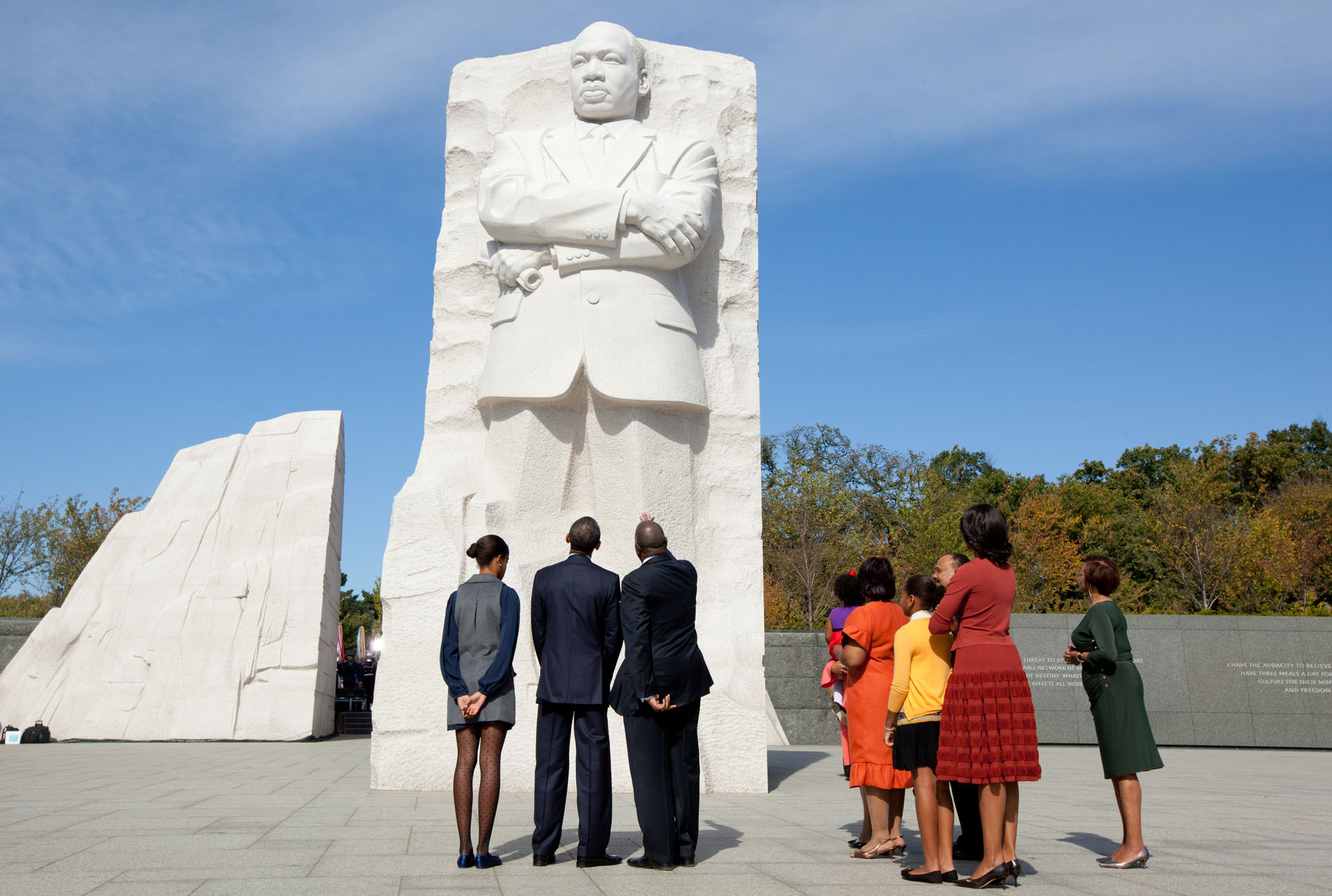
   President Obama and the First Family tour the Martin Luther King Jr. National Memorial
                         
                    President Obama visiting the new Martin Luther King memorial (Oct., 2011) 
                                         (credit: Chuck Kennedy, official White House photo) 
                                     

On Saturday, a couple of days ago, I wrote about the recent controversy over whether statues of Robert E. Lee should be removed from public spaces in the U.S. I tried to show that while it is reasonable for us to admire Lee's courage and intelligence, we should still highlight at the same time that he made a mistake. Millions of others had made the same mistake in every nation of the world for centuries. Their mistake was that they allowed and supported the institution of slavery in their communities. 

As I have said before, slavery is just wrong. Not in the sense that it is evil. Just wrong. My watch can be wrong. A thermometer can be wrong. The speedometer in my car can be wrong. A cancer diagnosis can be wrong. Not evil. Just mistaken. 

Lee was making a huge mistake when he gave his support, courage, and intelligence to the cause of the Confederacy. That brief state's main point of contention with the rest of the Union was slavery. The South, by and large, wanted to keep it. The North, by and large, were opposed to it and wanted to see it abolished by law from the whole U.S. They fought and the North won.

But my point on Saturday was that we can admire Lee's courage and intelligence and decide, nevertheless, that he was wrong. We can disagree emphatically with his choices and we can say so in a public way. We can do these things without hating and fighting each other today. One of the crucial features of a democracy is that the people living in a democratic state agree to live by the rule of law. They elect people to represent them in the legislature which writes the laws that every citizen must abide by, and they agree to live by those laws. When they have disputes, they take them to a court of law to get them resolved. They do not take matters into their own hands. Once that vigilante justice begins, it deteriorates into endless revenge killings and rule by the biggest bullies around in the space of less than one generation. A return to the Europe of the Dark Ages. We have been there, done that, and don't want it back. We have learned, mostly, to settle our differences by talking rather than by physical fighting. 

So what do we do in a democracy when a division as deep and as darkly, racially motivated as the one in Charlottesville shows its ugly face right out in public? 

We engage with the other side in open discussion and debate. This is what democracy takes as one of its given assumptions. If we don't talk about a matter like the racism that is evident in the U.S. (and to varying degrees, in every other nation on earth, by the way), openly and respectfully, it will fester and erupt into violence over and over until we do talk about it. 

Therefore, I say again to the proponents of "white" pride and their cohorts (and by the way, I am an old, white male who detests racism of every kind): slavery was wrong as every form of racism is wrong because it is stupid. It causes a society that allows racism to go on to waste some of its best talent. Talent, we know now, is spread over all races, genders, creeds, and ethnicities. It is just smart business for us to learn to accept, respect, and come to like people of all groups in society. Then we are much more likely to get the best person for the job in every case and to build a stronger, more prosperous, more peaceful nation and world. 

And we can teach the kids to see past race and gender differences. I used to tell the kids in my classes that someday a teacher in a school somewhere in the world will be working on a Social Studies project with her class about the schools in the U.S., or Canada, or any of a hundred places in the world in the 1960's. One group of students will be looking at copies of the forms that students had to fill out on the first day of school. Name, address, phone number, father's name, mother's name, and so on. That group will come to the teacher with one of the forms and show her one blank space that was supposed to be filled in by every student. Above the blank will be the words "racial/ethnic origin". The children will say to the teacher: "What was this?" And the teacher will say back: "I don't know." 

Can we learn to love one another, or at minimum, respect one another? All of us? All over? 

Martin Luther King thought so. Gandhi thought so. Nelson Mandela. William Wilberforce. Jesus Christ. Hildegard von Bingen. Jigonsasee. Deganawida. Tolstoy. Herman Hesse. Martin Niemoller. Sun Yat Sen. Mo Tzu. And so many other lovers of humanity who lived and died for decency and sense. 

And finally, we need to say plain and simple, again and again: What other choice do we have? 

We have nukes now. In the past, we could have wars over these very deluded differences. The past is done. Now, we either learn from it, learn to do better, or we go under for good. 

So once again, in the shadow of the mushroom cloud, nevertheless, have a decent, kind day. 


   File:Sun Yat-sen sculpture.JPG

                                           Sun Yat Sen, early 20th century Chinese leader and hero 
                                                (credit: By JHH755, via Wikimedia Commons)


Saturday, 16 September 2017

   File:Lee Park, Charlottesville, VA.jpg

                        Statue of Robert E. Lee on his horse, Traveller, in Charlottesville, Virginia 
                                             (credit: Cville dog, via Wikimedia Commons)


Today I write of the importance of wisdom, which to me means thinking about the concepts on which we base our thinking. It is only when we analyze our most basic ideas that we have at least a chance of gaining what we call "wisdom". What ideas are we taking so much for granted that we never even examine them? Why do they matter?  


The photo above is of the statue of Robert E. Lee in Lee Park in Charlottesville, Virginia. As of this writing, it is still in place. Attempts to remove this statue caused a lot of trouble when protesters who buy into an obsolete version of U.S. history demonstrated against the statue's being removed. These protesters who still honor Lee were confronted by counter-demonstrators who find the statue offensive and long overdue for removal. It is worth mentioning that there are dozens of memorials to Lee across the U.S. South and hundreds of other public reminders of him, including roads, counties, and public schools named after him. 


But across the whole U.S., there are thousands of statues of thousands of people. Why have the ones of Lee caused so much controversy in recent weeks? The answer is complex and nuanced as most issues involving people are when they're examined closely.  


Lee was the most famous of the Confederate generals in the U.S. Civil War that occurred from 1861 to 1865. That war killed more U.S. soldiers, North and South, than all of the other wars that the U.S. has been involved in combined. It tore the young nation apart. The psychological wounds are still raw for many Southern white people, whose short-lived Confederate States of America was ravaged by Union (Northern) soldiers, in some places for hundreds of miles. The Northern general, Sherman, told his soldiers to steal, burn, and smash, and they did. 


On the other hand, African-Americans see the Civil War war as being an attempt to correct one of the most immoral social institutions ever put in place in the U.S. or any other nation in history. 


Slavery is ugly, even as a concept, let alone when put into practice. The heroine of Toni Morrison's novel "Beloved" murders three of her children rather than let them fall into the hands of the slave catchers. Morrison makes that horror and tragedy totally believable. In a true life case, Solomon Northrup spent twelve years in slavery in the U.S. South even though he had been born a free man in New York state. He was kidnapped and sold into slavery as a grown man. His descriptions of the abuses he saw sound honest even today. And terrible. No clever justifications given for slavery - and plenty can still be found in the newspapers of the Old South - could ever justify this barbaric practice. No one should be permitted in any society to own another human being like we can own a horse or a dog. Slavery is a dysfunctional, perverse practice; it leads to rape and murder as a way of life. But who in a slave-based society could tell the cruel owners that they were wrong? In the slave states, it was all legal. 


Lee was only one Southerner. There were millions of them and they owned millions of African slaves. Lee was a very smart man. First in his class at West Point before the Civil War started. Lincoln asked him to head up the Northern armies, but he declined, returned home, and in a few weeks took over as the general of the Army of Northern Virginia. Then he fought a bloody war which ended finally in the utter defeat of the Confederacy. 


Now let's be clear. Lee was a very smart man. No one in West Point during his time there was near as clever. He was also very brave man and a capable one. He could devise and implement strategies that really got results and won him nearly all of his battles. But in spite of all of these things, he was wrong. 


It is quite possible and in fact, fairly common, for brave and clever people to make mistakes, not just about the time or whether they are smelling pork of chicken cooking in the kitchen or who was the Roman general at the Battle of Zama. All of us, sometimes, screw up. We make mistakes, sometimes even about the most crucial matters in our lives. Lee did. As did Jefferson and Washington, and many others all through history, not just in the U.S., but in nearly every nation on earth prior to the 1800's. Slavery was widespread including in the Orient, Africa, and the Americas. And it was a foolish, painful error every time. No one can own another human being and call her or himself "moral". 


In this space, I have many times argued that moral values that work - i.e. that lead the people who live by them to happiness and prosperity - are the responses of human societies to the real, physical world. In this space, moral realism has been, and continues to be, my main thesis. 


So why is slavery wrong? Because more than anything else - more than its being condescending, cruel, or corrupt - it's just stupid. 


Over the long haul, a society has to deal with the uncertainty of reality. Always, the community must meet and handle challenges that no one could adequately foresee. We try to learn from the past and we make what provision we can to prevent disasters, but always surprises, some of them potentially deadly to millions, come crashing out of the future toward us. That is reality. There is no changing that characteristic of reality. 


Our smartest strategy over the long haul, not so much if we want to be nice, but just if we want to survive what the future is going to throw at us, is to build a community and a nation in which there are all kinds of people with all kinds of talents and knowledge bases, and they all get to develop the gifts that they have. Then, when disaster approaches, we have better chances of having someone in town who can see how to stop the disaster or dodge out of its way. 


This is why freedom and loving your neighbor matter so much. Yes, those values sound nice, but no, that is not the reason why they are precious. Properly speaking, they should not even be called "precious". They're crucial. They raise our odds of going on, as much now as they ever have. We've spent literally milennia learning them and teaching them to the kids a little more with every generation because ...over the long haul ...they work.

So yes, Lee was a clever and brave man, and yes, he was sincere. He was just wrong. And it is in that light that he should be presented, like Washington and Jefferson, and for that matter, Edmund Burke and Alexis de Tocqueville and thousands of other famous people who supported slavery. 


They were just wrong. They were right about lots of things, but in this vital area of their lives, they made an error. My watch can be wrong. The thermometer hanging outside of my door can be wrong. "Wrong" does not mean evil. It means mistaken. But wrong is still wrong. Slavery is wrong because, over generations, it doesn't bloody work. It makes the society that allows it weaker and sicker with each generation that passes. 


So yes, it is long since past time when the monuments to Robert E. Lee were taken down. Or at least, taken out of public spaces. They could perhaps be tolerated in museums if the talks given to all who visited the museum closed with some remarks like these: 


"This man was brave, clever and sincere. But about the Confederacy and the social institutions that it was trying to preserve, he was wrong. Those institutions were centuries out of date and long overdue to be abolished. Subsequent events, evidence, and experience have shown us over and over that there are some good people, some bad, and some mistaken people in every group of people on Earth. As you leave this museum, it would be wise to meditate on how easily any of us can make a mistake. And sometimes cling to that error for a lifetime. Leave here more determined to be the best you that you can be but also leave here determined to let all other persons, as long as they are not directly harming you, be the best version of themselves that they can be. Love freedom and love your fellow human travellers on this journey from womb to grave. Live these values and teach them to your children. Do all this with the aim constantly in mind of preventing a war far worse than any of the ones in the past that destroyed the lives of so many intelligent but mistaken people like the Confederate general, Robert E. Lee."


                        File:Robert E Lee statue removed from column New Orleans 19 May 2017 12.jpg

                                  Lee's statue being removed in New Orleans (May 19, 2017)                                                         (credit: Infrogmation of New Orleans, via Wikimedia Commons)


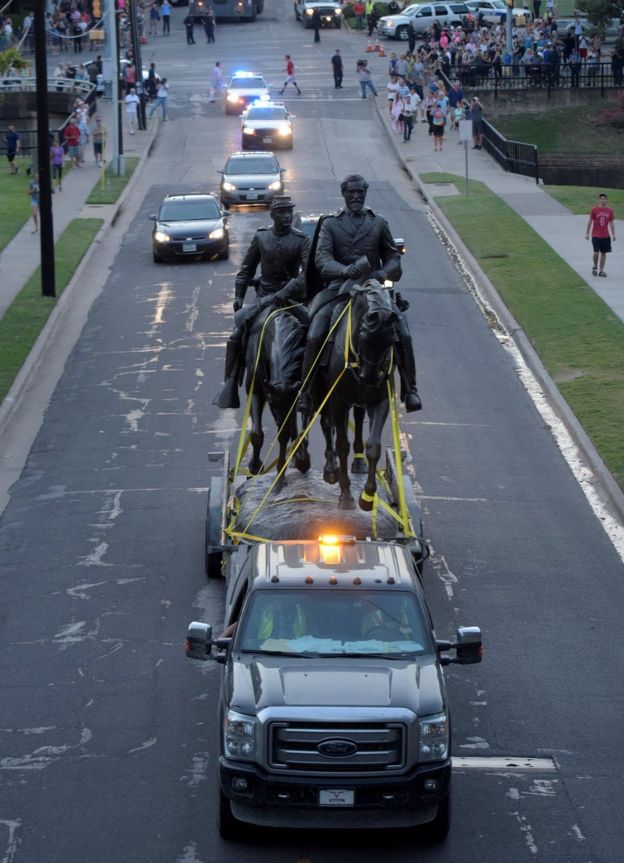
                               The statue of Confederate general Robert E. Lee is escorted after removal from its platform in Dallas, Texas, U.S., September 14, 2017

                             statue of Lee being removed from park in Dallas, Texas (Sept. 15, 2017)
                                             (credit: Reuters news service, via the BBC) 

Saturday, 9 September 2017

The book is done. It began April 13 and has gone up in posts of roughly 500 to 1000 words almost every day since that April 13 start date. If you have found my view of the world, of the concepts humans call "values", and of the case for theism interesting, you may re-read the whole book by starting at the April 13 post and following all the posts since then.

But I am not re-writing the book again anytime in the foreseeable future.

However, I am not done with posting in this space.

I intend now to post an article every few days in which I apply the moral realist worldview and reasoning to events and issues currently in the news and on people's minds.

For today then, here is a post I wrote back in March. In it, I explain why I think postmodernism is so misguided and dangerous. The biggest "ism" shaping the thoughts and worldviews of millions of young people in universities all over the world ...and it is founded on a mistake in basic logic. Read on.

_______________________________________________________________________________

In my own thoughts, I go through new arguments showing that postmodernism is incoherent and dangerous on a daily basis. It scares me that much. But here is one more argument. 

If there is nothing outside the text (as Derrida once put it), then there is no such thing as some material world event or object or process that any one of our words actually refers to. The process of communication during which we get the meaning of someone else's speech or article is all happening inside of an inescapable network of words and in the end, all the words can refer to is each other. There is no "outside" source of meaning. 

Then what happens if a dedicated scholar who speaks two or more languages translates a work? Even, let's say for the sake of argument, one of Derrida's works or Foucault's into, say, English? Are there such things as better translations and worse ones? If so, how on earth could any other scholars judge a translation to be a "good" one? It gets at Derrida or Foucault's intended meaning more accurately in the new language? What "meaning"? One outside the text? I thought they said that can't exist. 

You see, here's the real stunner. If at a very fundamental level all communication is just the bandying about of familiar sounds or marks on a page between people who share a set of conventions about their ways of venting their feelings  as they process "texts" (which is all that's left if deconstruction is correct), then genuine communication of anything substantive from outside of this particular communication act cannot happen. But it does. 

"Careful. That patient has AIDS." or "Watch it! That truck driver can't see you in his rearview mirrors!" Does the content of these communications or others like them matter? How could it if there is no way we can talk to each other about "matter"? 

At the level of fundamental, subconscious understanding between the parties involved in any act of communication, the postmodernists ask us to accept that we aren't really communicating anything of substance ...while simultaneously we actually are. 

This is the equivalent of our accepting, again at a level we aren't normally even aware of, a logical claim of the form "A and not-A". My friends trained in Symbolic Logic, I hope, should be having a calf right now. If we accept "A and not-A" in any set of statements in any system of logic, what we can then conclude is ...anything. ANYTHING. 

Yes. That is how grand an illusion postmodernism is. Little wonder that people in Anthropology and other fields who have fallen under the pomo spell can listen to arguments reviling a given cultural more or practice and then some other arguments defending it, in the same speech or article, and agree with them both. 

Everything is everything. Everything is everything. Distinguishing between things in the physical world becomes impossible. We can't trust any such communications. They are all illusions. I can ignore a grizzly bear stalking my unaware friend. If I don't tell him anything bad, nothing bad can happen. 

The problem is that right at the level of individual human sanity, we survive and navigate through the day by watching events around us and responding to them in mostly effective ways that we can only devise based on concepts that are rooted in sense data. In the real, material world, words name concepts and categories of things that then enable ways of organizing sense data and reacting effectively to them. Being able to talk to one another about the things we can agree we both see in reality is a useful trait we picked up when we acquired language. To now decide that we don't need any ways of talking about meanings that come from outside the communication act is to turn our backs on 200,000 years of human evolution. For what? Smugness? Complacency? Niceness? 

A human who no longer has any trusted concepts in place becomes catatonic. Sits and stares and drools. And yes, concepts sometimes can be inaccurate or even wholly mistaken. But there is no chance of one person helping another to see that if no reference to evidence outside of the debate is possible. 

Postmodernism, in short, makes a game of playing at the borders of insanity. So clever. Aren't they brave? 

Why on earth would anyone ever cook up such a worldview? I think I see why. 

The human mind is naturally powerfully disposed toward cognitive dissonance reduction. In any situation in which we feel that our basic beliefs and values are threatened, we are very creative at finding explanations for the events or texts that are disturbing us. Explanations that make the upsetting events or texts seem trivial, unimportant, or mistaken. Whatever works to reduce our cognitive dissonance. Deep inside, we need to like ourselves. The biggest lies we tell are often the ones we tell ourselves because we need to. 

In Europe - and especially in France, where Derrida and Foucault and their mentors, fathers, and uncles dwelt - after World War Two, millions of people had stores of memories so painful that they did not want to look at them. Across Europe, new lows for humanity were spoken and performed by people in all walks of life. Doctors did grotesque medical experiments for the Nazis. Judges enforced grotesque laws. University professors taught "German" Science. Clergymen. Lawyers. Teachers. Welders. Carpenters. Drivers. Laborers. Women who were homemakers screamed themselves hoarse in joyous response to Hitler's speeches. All of them not only abandoned their Jewish neighbors and colleagues, but even turned them in to the Gestapo. And then felt righteous about it. Frenchmen and many others fought against the Nazis and then for them and then against them and over and over, against each other. What did that toxic time and its aftermath after Germany had been beaten do to intense young men like Jaques and Michel? How could proud young men adust to such painful humiliation? 

Deconstructionism. Post-modernism. Everything is everything. It's all fiction anyway. Narratives, every one of them as true as any other one of them. 

Think of the ambivalence, anger, and sadness you stir up if you try to talk to the Baby Boomers in the U.S. about the Vietnam era. Then multiply that by at least three times. 

Postmodernism is a rationalization in the whole consciousness of Europe, but it has spread to much of the rest of the human race because it is so tempting. So comforting. We like to be nice. The problem is that reality sometimes isn't nice and what we don't acknowledge we can't fix. 

So let's close today's post with a challenge. 

Postmodernists: If the field of History is made merely of a bunch of "narratives", every one of them just as true as every other one of them, then ...did the Holocaust happen or didn't it?


                                           Gate into Auschwitz death camp (credit: Wikipedia)