Friday, 17 February 2017


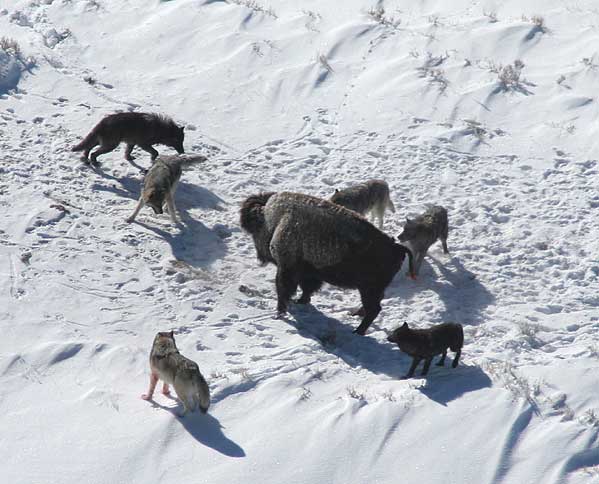
                                                    Wolves closing in to kill bison (credit: Wikipedia) 

In this book, wisdom is seen as being a prime virtue. For example, in the economic sector of our society, we all need to be wise enough to grasp a lesson. When there is a lesson as glaring as this one to be found in the history recorded by our forebears, refusing to learn that lesson would not just be unwise; it would be suicidal. Modern business leaders and union leaders, however much they may dislike one another, have by and large grown wise enough to see that they need one another. Dynamic balances make our society work. It is only in adjusting the balances that we argue. Over time, the wolf pack keeps the caribou herd strong, and vice versa. Unions and managers keep each other strong. 

And this discussion of the ways in which social evolution driven by cultural changes can be compared to physiological/anatomical evolution driven by genetic variation can be pursued further. The discussion is worth the trouble because it reiterates a main claim of this book, namely that these analogies between genes and memes are not just figures of speech. They are ways of describing material reality. The idea that cultural adaptation is the key driving force in human evolution fits the evidence.


                                        Prickly pear cactus, Utah, USA (credit: Wikimedia Commons) 


                                            Flowering cactus, Jordan (credit: Wikimedia Commons) 

For example, in biology, convergence is the term describing the phenomenon seen in species that are widely separated geographically, but that, after millennia of evolution, are found to be using near-identical strategies for survival. For example, desert plants of widely differing species, in widely separated deserts, have waxy leaves. They also put off flowering and reproducing for years until that rare desert downpour arrives.


      Native elder Agnes Baker Pilgrim with her granddaughter (credit: Wikimedia Commons) 


                  Grandfather and grandson in Indonesia (credit: Wikimedia Commons) 


Similarly, nearly all human societies that have made it into the present age, with vastly disparate cultures and from widespread geographic areas, respect, value, and heed their elderly. In pre-literate tribes, an old person was a walking encyclopedia of the tribe’s accumulated knowledge. What the old had stored in their heads about hunts, crops, cures for diseases, etc. could save lives, even save a whole tribe. This universal respect for the elderly demonstrates convergence in the cultural realm. The meme-gene analogy works. 

Thursday, 16 February 2017

There are some even more nuanced ways of seeing balance in this labour-management subsystem within our society. One truth is that while most smart business leaders secretly hope they can achieve a modest settlement with their workers, they also hope the rest of their society’s workers will get generous new contracts. That will mean more disposable income in the economy, money that workers, who are simply consumers during their time off, can spend on the smarter business leader’s goods and services.

The corollary is that while any one group of workers wants generous rates of pay in their new contracts, they don’t want to see generous pay packets being handed out in all the contracts signed in other sectors of their society. If settlements in general are modest, workers know that goods will be cheaper, relative to their wages, than those goods were just a few months ago. If they are honest, most workers will admit to wanting their own company to succeed above others. Their jobs depend on it. Some of the leaders of their company may seem unsympathetic and unyielding at times, but smart workers know that managers who watch the bottom line, as long as they also know how to adapt to innovations and to market their goods in creative ways, are the ones the company needs if it is to stay in business and keep workers employed.


In short, in the modern business world, smart business people don’t espouse Social Darwinism and smart workers don't espouse Marxism. Democracy in all its sectors runs by maintaining interactions and tensions between complex, balanced systems of values and concepts, or, to put the matter more exactly, between the groups of people who carry those concepts and values in their heads and then live by them.

Wednesday, 15 February 2017

Let’s briefly consider an example that shows how values in real life must reach dynamic equilibrium in order for us simply to function. This particular example of how values shape human relations is relevant because it can be seen as a paradigm of how humans today really do relate with each other in all areas of their lives, professional and personal.

A captain of industry in the West today has times when he despises unions, but he has come to accept that if workers are not paid a fair percentage of the company’s earnings, they will work less and less efficiently. He may find ways of retaliating through punitive measures, but he knows those will simply cause the cycle to deepen and worsen. If the obstinacy on both sides becomes hardened enough, violence is inevitable. If those who own the means of production—farms, dams, mines, factories, etc.—become even more incorrigible in their attitudes, the whole society will eventually break down into revolution and chaos. To prevent such chaos and to preserve his way of life, the smart CEO must have ambition and drive (courage), but also wisdom. A smart owner or CEO works with, not against, his workers.

Thus, we have learned, by trial and painful error, to aim for balance. For example, workers in Western democracies have rights to safe working conditions and free collective bargaining via their unions. Smart business people negotiate with unions, and contracts are arrived at by debate and compromise. In fact, the most successful business people in the West today are those specifically trained to be skilful at labour-management negotiations.


                                 union and management reach a contract (Ford Motors 2007) 
                                                                 (credit: Wikimedia Commons) 


For their part, most union leaders today know they have to respect a company’s ability to pay. They ask for reasonable wages and benefits for their members, but most of them don’t try to push the owners to the brink of insolvency. To do so would simply be irrational. Union leaders must have drive and wisdom in balance as well. Furthermore, most business leaders in the West have accepted that as long as prices go up, workers will expect wages to go up accordingly. 

Making their business or factory more efficient by smarter management and ongoing research and development rather than by union-busting is what the ethical, deserving business people do. Most attempts at union-breaking are generally viewed as being rooted in managerial incompetence.

Tuesday, 14 February 2017


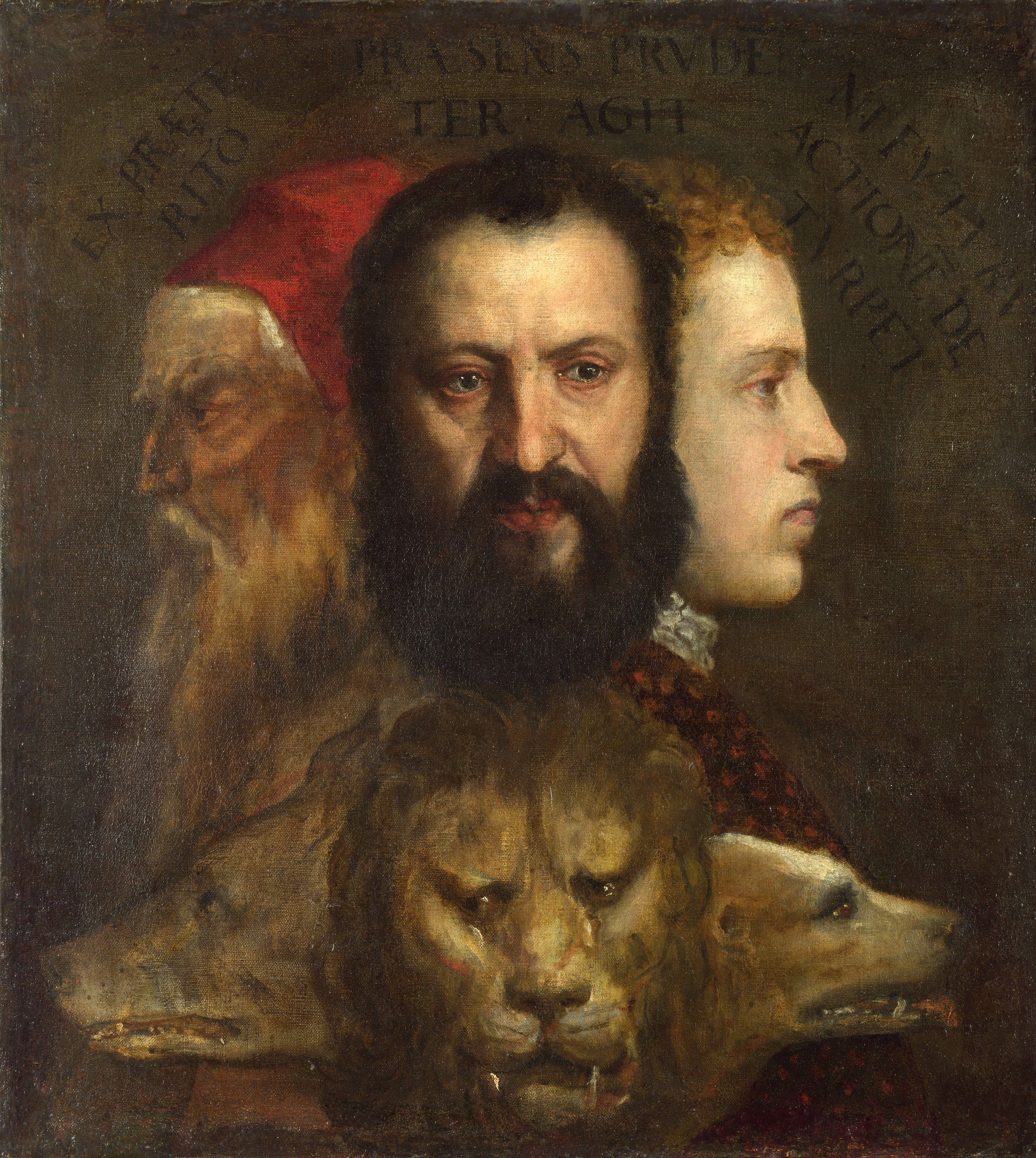
                                                 Allegory of Prudence (Titian)    (credit: Wikipedia) 

But now let’s return to our main point. A kind of field underlies time. At least two different types of codes guide living matter across that field, out of the past, across the present, into the future. These two types are the genetic and the cultural. Other life forms elsewhere in the universe may have found formulas for neatly balancing the momenta of these two codes, but in the human case, the relationships between genetic and cultural programming are not yet well understood. However, the point I emphasize in this book is that the cultural mode of evolution that has emerged in natural history so recently responds to environmental changes and pressures in ways that are subtler in their consequences than the genetic mode is. In short, it’s obvious that humans out-manoeuvre all other species on this planet.

Thus, a digression on the analogies that exist between the genetic way of evolution and the cultural one is in order here. The parallels have been noted before, by the Social Darwinists in particular. However, the conclusions of the Social Darwinists are considered by most people today to be disgusting, and rightly so. To put it bluntly, Social Darwinists conclude that rich people are rich because they are superior. They deserve to be rich because they know how to run society, while the workers, who in many places in the world are still miserably poor, deserve to be so because they don’t know how to run much of anything.

A few decades ago (in 1789), some rich Frenchmen lived by this code and found to their sorrow that it contained the seeds of its own destruction. To persuade any who still want to live by that code, I offer the harsher lessons of the Russian Revolution. Then come the ones in China, Cuba, Vietnam, and many others. And the very near miss in the US in 1931. This evidence contains some hard lessons for the nineteenth-century-style Social Darwinists in societies all over the world: if you want to live, be nice.

But how could it have been otherwise? The social milieu in which the Social Darwinists of earlier times lived was not very loving or free or wise or even brave. They saw cruel indifference, wastefulness, and arrogance as being necessities of not just their society, but any human society. Subsequent experience in countries all over the world has shown that, on the contrary, societies containing more compassion and justice can work, and do work, and ordinary folk all over the world today realize it. They will not accept misery, exploitation, and bare subsistence as necessities of social living anymore.


                 Teamsters’ union members vs. police, Minnesota, 1934 (credit: Wikimedia Commons) 

Monday, 13 February 2017

Chapter 15 – Cultural Evolution and Genetic Evolution: Parallels


                                                             Earth seen from space (credit: Wikipedia) 

What makes the earth’s biomass—its living ecosystem—so different from any other entity we have discovered in the universe so far is the way the whole interconnected system tends to keep becoming more in its mass and in the space it occupies as we move forward in time. All other entities in the known universe shred and spindle out across the time axis. But life on this planet has formed a system of fibres that somehow keep pulling in more matter and energy, trapping them, organizing them, and using that mass to keep making ever increasing amounts of living matter.

The kinds of forces that somehow create life, this anti-entropy pattern in the flows of matter, are still poorly understood—at least by us. There are programs written into the matter in the strands, codes that tell them how to make life expand instead of dwindle, shred, and fizzle out. We know that the main program for most of the species on earth is the one written in DNA, the basic molecule in the genetic system of life‘s programming.

But in the case of one living strand, namely, that which composes the human species, the main programming mechanism uses not copies of a code written in DNA molecules, but small coded energy exchanges (words, gestures, etc.) between fibres in the (human) strand to upload a nimbler program, the one that we call culture. Note that this metaphor of threads and weaving tries, inadequately, to portray a miracle. Life goes against the natural flow of entropy, the normal flow of the universe. Life shouldn’t be, but there it is. Even though we can’t say precisely how or why it is, we have to get on with it.

The model is an inadequate one, but then so are physicists’ models of matter and energy. All models used in the sciences prove limited. Electrons are not tiny bullets, even though that’s how they’re portrayed in high school physics texts.


        Sprinkled iron filings show magnetic field around a bar magnet (credit: Wikipedia) 

We now need to stress the view implied by the cultural evolution model that says values are designed, by the pressures of evolution, to respond to what is real. Living matter, with humanity as an ever-growing strand within it, moves forward through time not randomly, but in certain patterns. Just as electrons may inhabit only certain energy shells around a nucleus and iron filings scattered about a magnet orient along the lines of force the magnet’s field has created, so protoplasm moves forward through time only in those channels of energy flow that suit it and its ways of existing and enduring. Living creatures’ genetic programs—and, in the human species, cultural programs—make it possible for us to find and widen the life-suitable channels through the physical universe. Or in short, we learn from our parents and mentors the skills and knowledge we need to preserve ourselves and our homelands and to find/make new ones.


      NASA artist’s imagining of first humans exploring Mars (credit: Wikimedia Commons)  


There are patterns here. We have decades of research in evolutionary sociology ahead of us, designing models of cultural evolution, testing them against history, then planning—jointly, as citizens of a democracy—how we may best use the knowledge gained to consciously shape our behaviour patterns and those of our children, in ways that will maximize our courage, wisdom, freedom, and love and so lead to our making ever-expanding biospheres, on earth and beyond.


However, accepting that there are patterns to human cultural evolution and that it is not random has enormous implications before we even begin our research. If this model of reality is roughly correct, time can be viewed from outside of time as a kind of field. In order to survive and flourish, all living things must practice behaviors that steer them into the life-sustaining, Goldilocks zones of the energy streams (not too hot or too cold, not too fast or too slow, not too large or too small). The best values codes steer us into patterns of group movement that maximize our survival probabilities. At this early stage of our history, we don’t understand and don’t see down the path to survival very well. But we can see that the largest of these patterns are the ones we describe with the terms freedom, love, courage, and wisdom.

Sunday, 12 February 2017

For a page or so, let’s pursue this line of thought. We know that the matter in the universe itself at levels of resolution far smaller than the simplest life forms is pulled into its shapes—in fact, into its existence—by balanced sets of opposing forces. The earth in its orbit is being pulled toward the sun by gravity and flung away from the sun by centrifugal force. In this dynamic state, our planet orbits through a band of space fit for the thing we call life. The nuclear strong force and weak force alternately work to dissipate matter into nothingness or crush it out of existence. In balance, they pull the nuclei of the atoms around us into their shapes. Electrons are held in their orbits by balances of forces, like planets and stars. As we find ways of balancing courage with wisdom and freedom with love, humans mirror the universe itself.

We need internal tensions in our communities. Pluralism is an indicator of a dynamic, vigorous society. Societies that aim to be monolithic and homogenous lack resourcefulness and vigour. A democracy may seem to its critics to be enervated by the energy its people waste in endless arguing. But over time, in a universe in which we can’t know what hazards may be coming in the next day, year, or century, diversity and debate are what make us strong. Indulging in self-deluding, wistful thoughts of ending uncertainty and its attached anxieties leads us away from love for our neighbors, from pluralism and from freedom. Therefore, love is not merely nice: it’s vital. It has brought us this far, and it is all that may save us.

A basic Buddhist truth is that life is hard. Another is that only love can drive out hate. Jesus’s number one command to us all: love one another as I have loved you. These codes have not survived because a bunch of old men said they should; they have survived because they enable their human carriers to survive in the real, empirical universe. In short, our oldest, most general values have survived because they work.


       Socrates with Aspasia an Athenian woman (by Monsiau) (credit: Wikimedia Commons) 


Courage is the human answer to entropy, the adversity of reality. Wisdom tempers courage. Freedom is the human response to (quantum) uncertainty. Love guides freedom. Diligence, responsibility, humility, and many other values are hybrids of the four prime ones. They show their value only on a huge scale as the daily actions of millions of people over thousands of years, in societies of increasing dynamism, keep evolving and getting good results. But values are not trivial theories or preferences, like preferences for specific flavours of ice cream or brands of perfume. They are large-scale, human responses to what is real.

The largest purpose of philosophers is to give ordinary folk—by precept and example— such clarity of conceptual and moral understanding that they feel renewed and inspired to keep getting up and trying again to get to build their society right.


Notes

1. Friedrich Wilhelm Nietzsche, Thus Spake Zarathustra: A Book for All and None, Part XXXIV, “Self-Surpassing” (1883; Project Gutenberg). 
http://www.gutenberg.org/files/1998/1998-h/1998-h.htm#link2H_4_0004.

2. Kenelm Henry Digby, The Broad Stone of Honour; or, The True Sense and Practice of Chivalry, Vol. 2 (London: B. Quaritch, 1976). https://archive.org/details/broadstoneofhono02digbiala.

3. Thomas Carlyle, Past and Present, Chapter 11 (1843; The Literature Network). http://www.online-literature.com/thomas-carlyle/past-and-present/34/.


4. Melissa Lane, “Ancient Political Philosophy,” Stanford Encyclopedia of Philosophy, 2014. http://plato.stanford.edu/entries/ancient-political/#SocPla.

Saturday, 11 February 2017

Freedom, as a value programmed into children, is useful to society. It drives all, the young especially, to develop talents and live motivated lives. But, if it weren’t tempered and complemented with love, freedom as a social value would beget cliques and subcultures, then xenophobia, then suspicion, then prejudice, then strife, then anarchy.
Brotherly love, as a widely accepted basic value, solves this dilemma for society. In Roman times, for example, love seemed so crucial to Jesus that he told his disciples to aim to live by love above all other virtues. He proclaimed that it was the one thing he’d taught them that they must not forget. Implicitly, he was saying that all other values—even courage and wisdom and their benefits—accrue from love.
“A new commandment I give unto you, that ye love one another as I have loved you. By this shall all men know that ye are my disciples, if ye have love one to another.” (John 13: 34-35)
Thus, humans sustain and spread their societies by practicing lifestyles that may seem paradoxical to anyone who looks for all phenomena to be reduced to simple parts. Our behaviors and the values that drive them mirror the balance principle of their prototype—that is, the ecosystem of the earth. A culture is a self-monitoring and self-regulating system that is designed to respond to reality within strategically set limits or parameters—set by the values that it teaches to its citizens. Our morĂ©s can seem to be built on logical contradictions, but they are anything but. Rather, opposing forces, by constant interaction, create dynamic equilibria. 
This is basic systems theory. We couldn’t survive long in this uncertain reality, as individuals or societies, if our lives were otherwise. And the balances are tricky to find and maintain, but who really expects easy? Freedom is a precious, beautiful thing. If the price of it, over the long haul, is an honest, loving attitude and standard of conduct, there is a deep sense of justice and symmetry to that picture. A good life for an individual or her/his society is hard - but not impossible. Freedom only asks of us all we have to give.