Saturday, 22 July 2017

Under the Christian world view, the earth was the centre of the universe, specially created by God to house man, his most beloved creation. But man’s role was not to enjoy life as much as he could (as the ancients had) in this garden turned, by human’s sin, to a barren plain. Humans were here to praise God and gratefully accept all God sent their way, all joy and all suffering. Getting ready for the next life after death was what mattered. Humility and prayer. “Memento Mori” (Remember Death) was carved into the plaster base holding up the human skull on every scholar’s desk. This sounds like a backward step, and in many ways, it was.


                                      File:Aime-Morot-Le-bon-Samaritain.JPG

                                      The Good Samaritan (credit: Aimé Morot, via Wikimedia Commons)


But Christianity added some useful ideas of its own. Christians were taught to act humanely toward all other people, not just other Romans; to behave honestly and compassionately in their dealings with others; and to commit in a personal way to Christ’s kind of faith and his simple, honest, compassionate way of life. Christians were programmed to live as if being kind to all was a desirable, moral way to be, even if kind actions might not get any material rewards for their doer in this lifetime.

This was a big change from the ways of the slave-owning, gladiator-loving, sensual late-Empire Romans. Why the Church later became so cynical as to own property and then engage in wars while individual serfs were not to even contemplate such things (unless the pope told them to make war on the heathens) became vague. But the emotional grip and the social utility of Christianity’s ideas was so strong that hypocritical Church authorities found ways to steer ordinary followers’ thoughts past these inconsistencies.

For ten centuries, the Church’s explanations of the the universe and human experience in it were enough to attract, build, and retain a large following for the Church and the values and morés it endorsed. The values, in turn, fostered more honest and diligent communities, ones that began to get observable results. In evolutionary terms, that was all that mattered. 

Christian communities began to enjoy periods of increasing prosperity as their values created more and more internal stability again. Even though by modern standards, they were not very progressive, and by the standards of the glory days of Rome, not very affluent, the later Middle Ages were a big improvement on the violence and chaos that had come for several centuries right after the fall of Rome.

The synthesis of Roman patriotism and Christian compassion got more and more viable as the contradictions were worked out in the minds and daily lives of the citizens. Gradually, Europe began to climb its way back to order and prosperity once more. But it did so under a moral operating system very different from that of most people for most years of the Roman Empire. 

The behaviors Christian values recommended had seemed effete to the citizens of the middle Roman Empire. Compassion for the indigent? That was just stupid. A good horse was worth a thousand of them. Who was this Chrestus? What system had he offered that was luring Roman youth into its cult? The cross as its symbol yet! The cross was a symbol for losers.

But that system, which gave moral status to all humans (even serfs had rights), mutual support through all tribulations (war, famine, and plague), and honesty in all dealings (God watches us all) proved superior to the Roman one in the final test. Dissatisfied with what had become the Roman way of life, a life filled with material comforts and pleasures but devoid of ideals, more and more people became converts. When Constantine made the Christian faith Rome's official one, he was only acknowledging the social reality of his times. Christians had impressed a lot of people. They lived decent lives. Christianity was becoming popular.


   File:Jean-Leon Gerome Pollice Verso.jpg

                      gladiators in ancient Rome (credit: J. L. Gerome, via Wikimedia Commons) 


Christianity offered something new—a worldview that felt personal, a way of life that made sense as over the long term, it created more efficient, inclusive communities. As contemptible as Christianity seemed to mid-Empire Romans, who cheered themselves hoarse as men killed each other, it gradually assimilated the old Roman system under which it had risen. Its beliefs didn’t just sound nice; over millions of people and hundreds of years, they worked.

Friday, 21 July 2017

Note how the decline of the later Romans’ value system and their laziness regarding ideals of citizenship and honesty presaged that fall. Note also how we today understand intuitively the crucial roles values play in the shaping of citizens’ lifestyles and, therefore, in the success of their state. Ideals shape behavior and behavior determines whether a society will rise or fall. We know of this relationship at a level so deep that we take it to be obvious. When the Romans became hypocritical and corrupt, the collapse of their state became inevitable, we say. (Note that this idea is common among modern scholars, but it comes from Edward Gibbon, whose work on the subject is still, arguably, the most respected of all time.3)

But values and their material consequences are not obvious; the relationship between a society’s moral values and that society’s chances of surviving has eluded us for too long. In this twenty-first century, we must do better if we are to end the madness of war before it ends us.


   File:Constantine's conversion.jpg

                                                 Conversion of Emperor Constantine to Christianity 
                                                    (artist: Rubens) (credit: Wikimedia Commons)


What followed as Rome began to fade was the rise of Christianity. Did Christianity get strong because it offered Romans a way out of the cynical boredom of life in the late Roman Empire, i.e. programmed them to be driven by abstract values again? Or did it just happen to coincide with that cynicism? My position is that changes in values coincide with social changes because values changes lead to new patterns of behavior, ones that either help or hinder a society in its struggle to survive. Neither causes the other. They are both symptoms of deeper changes in a nation’s consciousness, but they are useful indicators of what’s going on in the consciousness of the whole nation. In this century, if we can learn how to plan and implement our own social evolution, we can end the horrors of our species’ past. That is what will happen if reason can defeat greed.


Christianity told people that the highest state for a human to aspire to is not citizenship. It is a state of grace, i.e. peace with God. This was easier to achieve in a monastery or nunnery. Renounce the world in all its tempting forms; focus on eternity. The balance between Christian values and Roman ones was hard to strike. When the Visigoths’ challenge came, too many Romans had let their ideals and behaviors decay for too long. The Christian community, in the meantime, had been taught to shut it all out. People who had integrated the two value sets, who could be passionately loyal to Rome and also to the rigorous moral code of Christianity, were too few to stop the barbarian tide. 

Rome fell, in an agony that we today cannot imagine. But the challenge was bound to come. One hundred fifty years is six generations – almost nothing in evolution’s terms. It took another thousand years for Europe to find a way to synthesize the ideals of democratic citizenship and those of Christian spirituality into a single, vigorous, practicable way of thinking and living. I will have more to say in coming chapters on that step in the cultural evolution of the West.  

Thursday, 20 July 2017

So, let’s return to our main line of thought. The Romans had a system that contained more discipline, efficiency, and practicality than the Athenian one. They built roads, bridges, and aqueducts of great size and engineering sophistication by employing knowledge they had learned from the Greeks, mainly the Athenians, and from their own neighbours, the Etruscans (or Tuscans). And some useful ideas were the Romans’ own creations, of course. Similarly, in other areas such as agriculture, medicine, law, and war, the Romans achieved practical successes unmatched in their times.
                                                                                

   File:Danseurs et musiciens, tombe des léopards.jpg

            Etruscan scenes tomb painting in Tarquinia, Italy (credit: Wikimedia Commons)

In addition, it is important to note that the Roman republic, as cruel as it could be to outsiders, was dearly loved by Romans. They were citizens of a democracy. They were a family. They truly thought that they deserved to rule because there had never been any state like Rome. It had been chosen by the gods to be specially gifted and destined. The state religion said so. The Aeneid said so. Thus, the Roman world view, by a direct chain of logic, assigned to the Romans the most important role that had ever existed in the history of the world. For them, their gods did not rule them and their universe with cruelty. Instead, for generations, the Romans were certain of where they stood: clearly, the gods (later, God) loved Rome.

                                 
   Cole Thomas The Consummation The Course of the Empire 1836.jpg

                   Glory days of ancient Rome (credit: Thomas Cole, via Wikimedia Commons)


This worldview produced an Athenian style of idealistic patriotism because it was built around a model that gave democratic rights to all Roman citizens, or at least all “true” citizens, namely adult Roman males who owned property. There were aristocratic families, as had been the case in almost all previous states, and these were accustomed to the idea of privilege. But there were also plebeians, and they too were full citizens with rights to vote, run for office, have a fair trial if they were charged with a crime, and so on. Ideals above any human individuals. How could one not love such a country? What would one not endure for her?

When slaves eventually became half of the population of southern Italy, the Romans viewed this situation as just part of the natural order. This view, by the way, that superior people must have slaves in order to have time to pursue nobler ideals and activities, did not originate with the Romans. It had been Aristotle’s view centuries before, and he defended it at length for reasons similar to those that the Romans subscribed to. These people were convinced, without thinking about it, that their country’s system and the patriotism that it fostered made them superior. They deserved to be the masters of inferior cultures.

But as the generations passed, Rome became a society built more and more on slaves and materialism, restrained only by a warrior’s code of discipline and loyalty. It had to collapse when the warriors ran out of territories to conquer and sank into boredom, sloth, envy, and internal strife. 

In short, the cultural code of Rome stopped evolving. Nevertheless, its remnants were used doggedly by its carriers, the Romans, until it became dangerously out of touch with the larger forces in its environment, many of which had been produced by the Romans’ own success. For example, neighboring tribes learned better ways of making war from the Romans themselves. And the problems of victory can be worse than those of defeat: people with too much wealth and time on their hands slip more and more into envy, plotting, corruption, vice, and greed. The natural direction of most humans is toward laziness, foolishness, and self-indulgence. 

A cultural code, like a computer operating system’s code, needs constant updating in order to stay effective in the environment that it must interface with every day. Code that does not stay updated leads to whole programs becoming obsolete as more efficient routines are devised by competing software companies. The consequences for societies whose code falls out of touch with reality, however, are more drastic than the consequences for an obsolete set of computer operating system protocols.

By the time the Romans realized that Rome really could fall, it was too late.


   File:RISD Couture Decadence of Romans.JPG

                     Late Roman decadence (credit: Thomas Couture, via Wikimedia Commons) 

Wednesday, 19 July 2017

   File:Juan de la Corte - Battle Scene with a Roman Army Besieging a Large City - WGA05366.jpg
                 
        early Roman army attacking a city (credit: Juan de la Corte, via Wikimedia Commons)


It is tempting to see in the Romans’ culture a synthesis of the ways of the Athenians and those of the Spartans. This is an example of Hegel’s dialectic: one way of thinking, along with the human groups that gather around it, forms and grows, and then an opposite way of thinking rises up like a kind of cosmic response to the first way. The two interact, struggle, and finally meld into a true synthesis, which is not a compromise because it is a new, coherent, unified way with a life of its own. Thesis, anti-thesis, and after a while, synthesis. That’s Hegel.

The people born into the new way are not aware they are using some elements from one philosophy and some from another. The new way is simply their way, and they add ideas to the new system till it feels like a seamless whole. Thesis, antithesis, then synthesis, over and over, with the system spiralling upward to greater and greater consciousness. This is Hegel’s model of human social evolution.

It is tempting. It is a fairly simple model, and with a little stretching it can be made to seem to fit in era after era and country after country when we study human history. But it is too simple. The Roman ways of thinking did contain some ideals similar to those of both the Athenians and the Spartans, but we know there was too much else going on in the thinking and living style of the Romans for us to accept Hegel’s model today. 

The Romans also came into power in the ancient world by a culture that was their own, evolved over generations of farmers who banded together to protect their farms and their families and built a city as a central fortress that would facilitate their realizing this goal. The Romans weren’t Atheno-Spartans. They were alien to all the Greeks in those times. They were, more accurately, first, a society that contained some elements that looked Athenian and some that looked Spartan, and second, capable of defeating any Greek army that was assembled against them. In short, History is subtler than Hegel's model. 

What makes more sense is to examine each historical society’s worldview, values, morés, and behavior patterns and observe how they coordinated to produce a whole culture and way of life that met the citizens’ survival needs at the time. Under that humbler view, we can learn much more about how human societies really work.

The model of human cultural evolution presented in this book doesn’t attempt to be as all-encompassing as Hegel’s thesis-antithesis-synthesis model simply because the process of human cultural evolution doesn’t fit Hegel’s model. Rather, the process of human cultural evolution is more closely analogous to the process of evolution in the rest of nature—by genetic variation and natural selection and accident and disaster.

Life didn’t move forward through time and proliferate into its many forms by the mechanism that Hegel describes. In the past, events like tsunamis, earthquakes, floods, droughts, volcanic eruptions, and even collisions with giant meteors suddenly closed down, or opened up, reams of opportunities. Then, usually, life forms moved into new habitats opportunistically. Life spreads across time and space not like a chain or road, but like a bush branching and bifurcating from that primal trunk started from a few cells eons ago.


The model of human cultural evolution presented in this book can’t match Hegel’s dialectic for attractiveness. Hegel’s model seems so neat and complete. But both animal life and human cultural life aren’t that neat. Our models of human culture must be grounded in the realm of the living. The model explored here can do what we need it to do. It can give us enough insights into how human cultures work, and what right and wrong are for us to be able to build a rational moral code. One that maximizes our odds of survival. And that is all we need.

Monday, 17 July 2017

Thus, in Western history, the next important worldview is the Roman one. Operating under it, people became even more practical, more focused on physical effectiveness and power, and less interested in, or even aware of, ideas for their own sake. Among many of the early Romans, this feeling expressed itself in a hatred of all things Greek; the truth was that, though they did not like to admit it, the early Romans borrowed heavily from the Greeks, especially in theoretical knowledge. Greek science and geometry enabled the design and building of the engineering marvels that the Romans constructed.


In their heyday, the Romans no longer feared the gods in the way the ancient Greeks or the Romans’ own ancestors once had. As the Republic faded and the Empire took over, the Romans turned so far from earlier thinking that they lost much of the Athenian capacity for abstract things—wonder, idealism, pure geometry, pure philosophical speculation, and flights of imagination. Later, they even lost their idealistic sense of duty to their nation. 

The Romans built their state on abstract democratic principles, values, and behaviors, similar to the Athenians, but like the Spartans, they loved real-world results and the physical power these lead to. They cared next to nothing for speculation about “the one and the many” or where parallel lines meet. Those were Athenian-types of mind games that to the Romans, seemed pointless, even silly. 


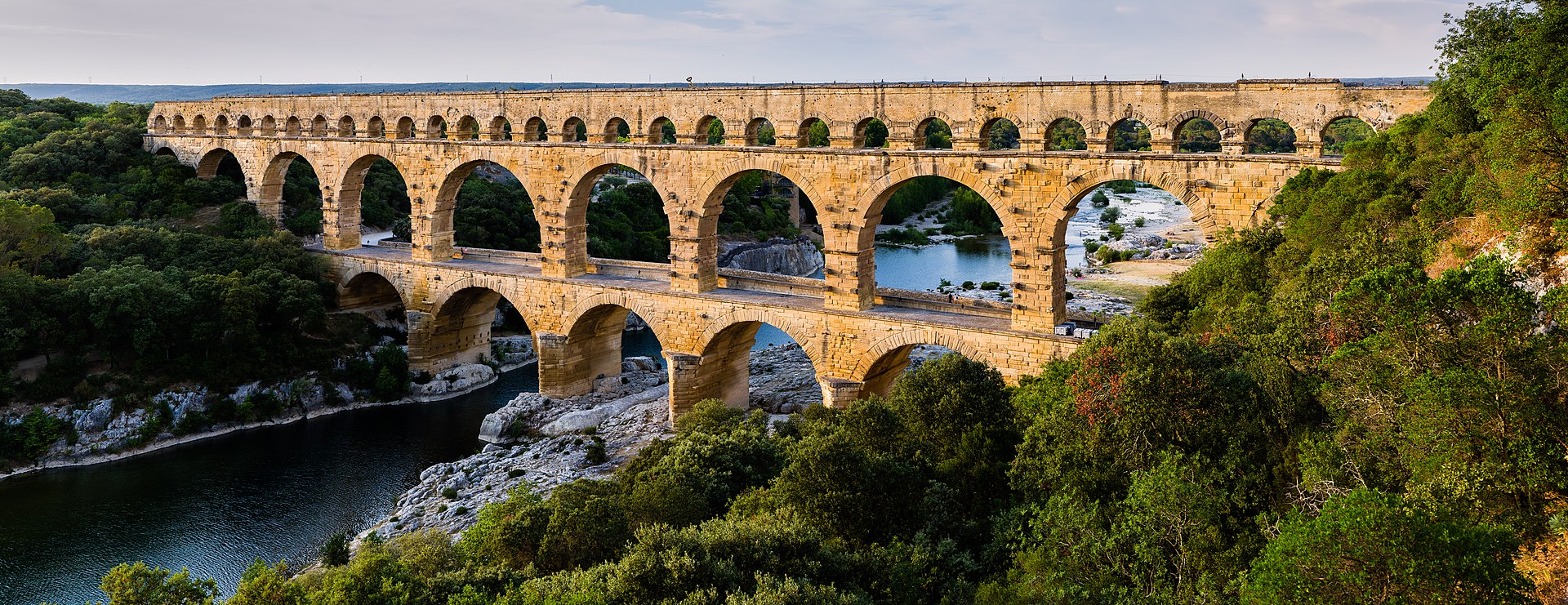
   Pont du Gard BLS.jpg

                 Pont du Gard (built in the first century A.D.) Roman aqueduct in modern France 
                                         (credit: Benh LIEU SONG, via Wikimedia Commons)

Sunday, 16 July 2017

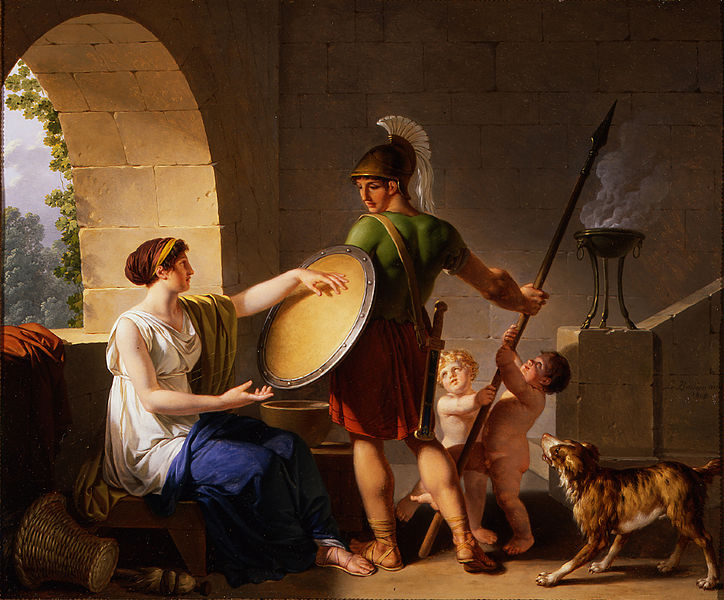
   File:Jean-Jacques-François Le Barbier - A Spartan Woman Giving a Shield to Her Son.jpg

        Spartan woman giving a shield to her son  (credit: Le Barbier, via Wikimedia Commons)

At the same time, their neighbours, the Spartans, were evolving their society, the perfect military state. The clash called the Peloponnesian War became inevitable, and Athens lost. A few years later, the Macedonians out-did the Spartans, and after another generation or two, the Romans ended the matter by conquering them all. 

In each case, a worldview, a set of attached values, and a set of behavior patterns, all blended into a culture, were tried against that culture's neighbors and proved just a little bit more vigorous. Evolution by constant testing and gradual increments, the same as in the genetic domain, kept bringing a new human social system to the top of the cultural food chain. Harsh. Real.  

And note also how cultural evolution by variation and selection of memes rather than genes is tenuous and scary, but also much faster and more responsive than is evolution by the genetic model. We can adapt to a changed set of weather patterns and grow a new kind of crop and live off of it because we can watch, form concepts, build mental models of reality and re-boot our way of life. In a generation or two. Not blindingly fast, but much faster than the genetic mode of evolution. Human. 


For better or worse, we not only adapt to changes in our environment (which always come), we also do it in a few generations. In the genetic, Darwinian mode of evolution, a few generations-long time span is nearly meaningless. In the human, cultural mode of evolution, what we call an "era" can be less than five generations. That kind of change fits the term revolutionary. It overturns almost every aspect of a tribe's life.  

Saturday, 15 July 2017

Chapter 11 – Pre-Renaissance Worldviews

Every society must work out and articulate a view of the physical universe, a way of seeing the world, a way that then becomes the base on which the society’s value system is to be built. This is no minor matter; while philosophers may dally over the questions in a theoretical way, real folk have to deal with life. They have to have some code in place that helps them decide how to live. World view, values, and behaviors must form a coherent system under which each individual is empowered to make decisions and take action so the entire society can efficiently operate, cooperate, and survive in its always changing, always demanding environment.

All societies know this in some deep way. Societies up until our time have integrated their worldviews, values, and morés to the extent that they have because people everywhere know implicitly that their worldview is their guide when they are trying to decide whether an act that feels morally right is practicable – whether what is called morally right can work in reality. No one wants to strive for what he/she believes does not exist.


Therefore, before we begin constructing this new system, we need to get our thinking into the necessary mindset by considering the most salient peaks in the histories of some societies of the past, in order to see how systems of world views, values, and behaviors coordinate and evolve. We shall get into thinking carefully about human societies and their ways of life by studying the past. 


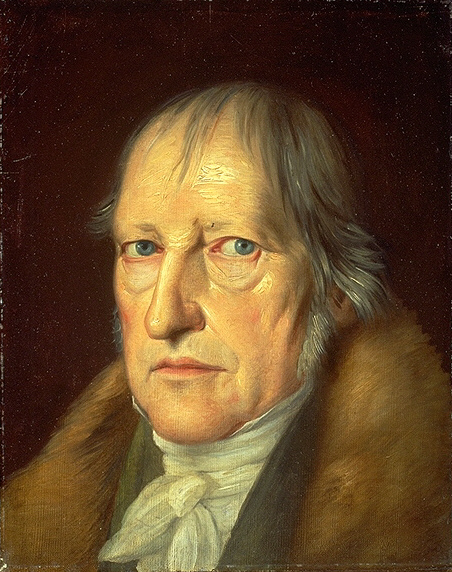
                         File:Hegel portrait by Schlesinger 1831.jpg

                              G.W.F. Hegel (artist: Jakob Schlesinger, via Wikimedia Commons)


In this chapter, Philosophy students will notice parallels between aspects of my ideas and the philosophy of Hegel, and I admit freely that similarities exist. But I also have some major points of disagreement with Hegel, which I will explain along the way. For those readers who are not Philosophy students, please note that I will give only a very quick version of my understanding of Hegel. If you find the ideas presented here interesting, you really should give Hegel a try. His writing is difficult, but not impossible, and it has also been interpreted by some disciples who write more accessibly.1 Now back to our analysis of the world views, values, morés, and behavior patterns that are discernible in the history of some of the societies of the West.

                                            
                                             File:Francisco de Goya, Saturno devorando a su hijo (1819-1823).jpg

                        “Saturn devouring one of his children” (Goya) (credit: Wikimedia Commons)


For instance, let’s consider the ancient Greeks, the ones who came long before Socrates’ time. They portrayed the universe as an irrational, dangerous place. To them, the gods who ran the universe were capricious, violent, and cruel, a phrase which also described the Greeks’ worldview. Under this view, humans could only cringe fearfully when confronted with the gods’ testy humors. Zeus, Hera, Poseidon, Ares, Hades, Athena, Apollo, and the rest were all lustful, jealous, cruel, and unpredictable. Zeus especially wielded thunderbolts; Poseidon could inflict earthquakes; Apollo, plagues.

But as Greek culture advanced, the Greek worldview evolved. By the Periclean Age, Greek plays were portraying humans challenging the gods. After all, they had been given the secret of fire by their patron, Prometheus. As the Greeks' worldview with its attached system of values evolved, it guided them toward a smarter, braver lifestyle. They began trying to explain reality in ways that made room for people to understand and manipulate the events in their world, not cringe away from them. Once their worldview included those possibilities, they began to create practical action plans that enabled humans to cause, hasten, or forestall more and more events in the world. They tried out the daring action plans, and when some worked, more daring plans followed. (Edith Hamilton articulates these ideas well.2)

It is important to see that human individuals and groups will normally not attempt any action they think of as taboo. Ancient tribes who happened upon an action that seemed contrary to, or outside of, what was appropriate for humans in their worldview only grew upset and fearful. Whether the action got results or not, the only thing most of those people wanted to learn was how to avoid putting themselves in the same situation again. They sought to avoid it for fear of bringing the gods’ wrath down on them. Once in a while, a genius might question his society’s worldview and even describe an alternative one, but he often paid dearly for such audacity—by being ostracized or put to death.
                                                                    
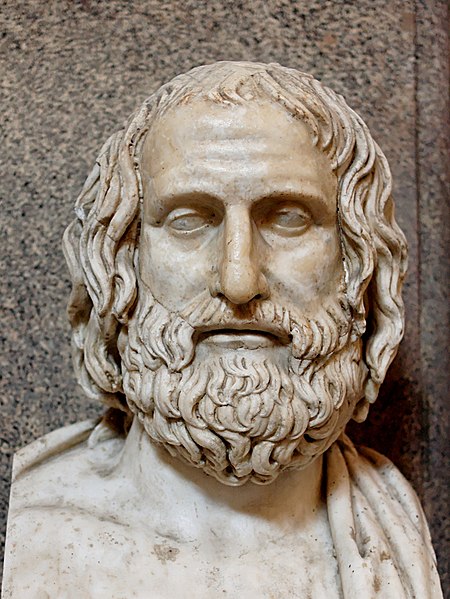
                            File:Euripides Pio-Clementino Inv302.jpg
       Euripides, Greek tragic playwright (credit: Marie-Lan Nguyen, via Wikimedia Commons)


However, changes in a society’s worldview and then in the society’s values and morés can also evolve more gradually, helped by many lesser geniuses. By the Golden Age of Athens, philosophers, writers, and artists were offering works that only a few centuries earlier would literally have been unthinkable. Their worldview had evolved to allow for at least some degree of human free will. The works of Plato, Aristotle, Euclid, Euripedes, and Pythagoras could only have been produced under a worldview in which a person could conceive of actions challenging the orthodox beliefs of the tribe and even the forces of the universe. Even though the challenge might only rarely succeed, once it did it drew adherents because it worked. It made life better.