Sunday, 16 April 2017

   File:Secretary Kerry Addresses Delegates Before Signing the COP21 Climate Change Agreement on Earth Day in New York (26514585911).jpg

          Secretary Kerry speaking at signing of Climate Change Agreement (Apr. 22, 2016)
            (credit: U.S. Department of State from United States, via Wikimedia Commons)


Even as a child, I did not believe in “miracles”; that is, events that lie beyond all rational explanation. I still don’t. Nor do I believe in the divinity of Jesus. Or, to be exact, I believe he had a spark of the divine in him, but so do all living things. He just had a lot more than most of us. But he differed from us in degree, not type. And miracles? They turn out to have rational explanations in the end.
                  
I knew even as a child that the important thing to understand was what the new deal Jesus offered humanity represented. The principles being represented in the stories were what mattered, and they seemed to me absolutely bang on. His whole worldview, for me, said that if we apply reason and love to what we know of our own history, we can find a path to survival—that is, to humanity’s surviving the hazards of its own success. In other words, once a critical mass of humans shares a model of reality that shows them how to fit into the natural world, while still respecting their fellow humans, they will live on in greater numbers than the ones who promote ignorance and war. Decency, sense, and love will prove fitter than cruelty and folly.

My faith was not destroyed when I gained an understanding of the scientific method. Nor was my passion for Science destroyed by my spiritual beliefs. The two clashed at times, my faith wavered for a while, but I gradually worked out a way to integrate the two and then to synthesize them into a new belief system—a single, unified, coherent one, whose power to guide, nourish, and inspire is greater than any power residing in our old Science or our old Religion alone could ever be.


The question in this Age of Science is “How?” How can a rational human being in the modern era feel full, confident allegiance to both of these ways of viewing our world and our place in it, these two ways that are considered, by most people, to be incompatible? 

The answer is that they are so far from incompatible that the plural pronoun “they” does not work in this context. Only a single concept is being discussed here. There is a way of understanding and reconciling all that we know, a way that integrates it all, from our observations of events around us to the memories stored in our brains to all the concepts we use as we strive to comprehend what we see and recall, and then to design effective responses to all of it. In short, when correctly understood, Science is Religion.

Saturday, 15 April 2017


      By ArchonMagnus [CC BY-SA 4.0 (http://creativecommons.org/licenses/by-sa/4.0)]
                                                                          (credit: Wikimedia Commons) 


One way to ease into the moral relativism versus moral realism debate is to explain how I came to be obsessed with it.

When I was in Grade 9, I was fortunate enough to have had a fine teacher for Science. He liked his subject, he liked kids, and he liked bringing the two together, which is all a good teacher ever really has to do. He impressed the thinking technique called the scientific method deeply into my mind. You get an idea or you imagine a model of how some part of the world around you works—how event A connects to event B. You think of a practical, real-world way to test the idea. You set up the apparatus you need, then you do the test. All the while, you keep careful records of what you observe.

Next, you analyze the data to see whether patterns exist that tend to support this theory or model of yours. You then develop further ideas for subtler theories, models, or tests, and you keep on researching. Sometimes you find a way to use your new insights about how the universe works to create technologies that enable humans to live in better health and happiness or in a little less pain. Once in a while, you find a way to formulate one of the basic laws of this universe.

I could see that by using this method, sharing their findings, and continuing their research, scientists had expanded human knowledge, created so many helpful technologies, and cured diseases—all in a steady march of progress. They had brought most of my way of life to its current state—one that was far safer, more comfortable, and more interesting than that known to any of my ancestors. Even at fourteen, I was filled with a rush of emotion each time I realized not only what had been accomplished but what might be still to come. It seemed to me then, and it seems to me now, that we are destined for the stars.

On the other hand, between the ages of six and eleven, I had spent most of my Sunday mornings attending Sunday school at St. Stephen’s United Church. I felt similar profound emotions when I learned about the Being who had created this universe and who loved everything in it. My six-year-old heart ached when I thought about how so many human beings had lost their relationship with God. The evidence was easy to see for myself. Humans are not very moral or even logical most of the time. Even as a boy, I could see this truth in events all around me, from the schoolyard to the Cold War.


But I was uplifted when I was told of one man who had explained to humans how they might strike a new deal: if they could learn to truly love one another—to follow his example—then they could regain their relationships with one another and, ultimately, their relationship with God. The key concept to grasp was that following Jesus’s way was what mattered, not whether he really was some kind of “divine“ being, and not whether the people I met belonged to one particular group or sect. Get to the practical. Love one another. Really love one another. Then peace, progress, and prosperity will all come. All of this was six-year-old naïveté, I admit. But as I look back even now, it seems more profound than the beliefs of many adults because it was clear, heartfelt, and unabashed.

Friday, 14 April 2017


                                                             Portrait of a young girl (Peter Chrestus) 
                                                                                (credit: Wikipedia) 


We have a reasonable chance of surviving on into the future only if we can work out a new moral code that we can all agree to live by. Every other path into the future is shadowed by a high probability of disaster. That is the dark side of the power Science has given us.

This book is an attempt to solve the dilemma of our time, the dilemma called moral relativism that has left us not so much struggling to live up to our ideals as wondering what those ideals are, and whether such things as ideals are even relevant in our world today. Moral relativism is a position in Philosophy that simply says there is no basis in the factual, scientific world for any moral values. "Right" and "wrong" are words that may make sense in a particular society at a particular time, but they are only tastes that most of the people in that society agree on for the time being. They change from era to era and place to place. In short, the only reasonable thing that one can say about morality, according to the moral relativists, is: "when in Rome, do as the Romans do."

On the other hand, moral realism says that there must be a factual, scientific basis for moral values, and then its adherents set out, with varying degrees of success, to try to find that basis.

In this book, I will work out a solution to that dilemma, a solution based not on so-called "holy texts" or personal epiphanies, but on reason backed by replicable evidence. However, I admit that readers will have to give their full attention to following the arguments I present here. My arguments aim to fill a tall order; they can’t be explained in a line or two.


I will try very hard to make my overall case a rigorously logical one, but I know it is also very much a personal one. I don’t apologize for this admission. I will discuss matters I believe are profoundly important for us all. My case is both logical and anecdotal, and my tone has to be both rational and personal. As the philosopher David Hume said, feelings drive thoughts and actions, not vice versa.5


                                                             By OmaOpEenBakfiets (Own work) [CC BY-SA 4.0                                                                                    (http://creativecommons.org/licenses/by-sa/4.0)] 

                                                                                     (credit: Wikimedia Commons)

Thursday, 13 April 2017


The Science God:

   Theism by Reason Alone


      by Dwight Wendell


Preface

Faith and reason are not enemies. But nor can they really be called friends. They are different aspects of the same thing. Science is simply the form that religion has taken in the modern world, and Science has both faith and reason embedded in it. That is the message of this book. But I know I will have to make my case well if I am to get readers to see that what I am asserting is so.

We live in an age that we like to think of as an age of reason par excellence. We assume Science and the methods of Science are increasing in influence in our world with every day that passes. We celebrate that fact because we have seen over and over that the majority of the cruel and stupid abuses of the past can be traced directly to the unscientific superstitions of the societies in which they occurred.

But at the same time, the moral codes we need simply to move through our daily lives, from the personal level to the global, have suffered serious damage in the last four centuries, largely because these moral codes haven’t held up under the scrutiny of Science. Most people today know this on some level. We are bolstered and encouraged by the material progress Science has brought us, but we are also frightened by the amorality of its world view. 

Science has made wonders. It just can’t tell us how or if we should use them.   
  
From the old codes of right and wrong, we keep getting directions that we can see are obsolete. Executing murderers, for example, is entirely counterproductive. In the meantime, the new gurus of Western society, namely the scientists, when they are asked to define right and wrong, say that Science cannot comment on morality or, worse yet, they flatly assert that all moral values are no more than fantasy concoctions, about as empirically real as Santa Claus.1

Science has given us the capacity to do harm on a planetary scale. Because of that, we need guidance; we need answers and not just piecemeal ones. We need a moral system that can tell us which of our actions are tending toward right and which are not. We can’t go on building nuclear weapons and polluting our planet without, sooner or later, having to face consequences. Environmentalists from Rachel Carson to David Suzuki have said we must stop the madness.2,3


   File:Beijing Air Pollution... (12691254574).jpg

                          Beijing air pollution (credit: Kentaro Iemoto, Wikimedia Commons)
                      https://commons.wikimedia.org/wiki/File:Beijing_Air_Pollution..._(12691254574).jpg                            

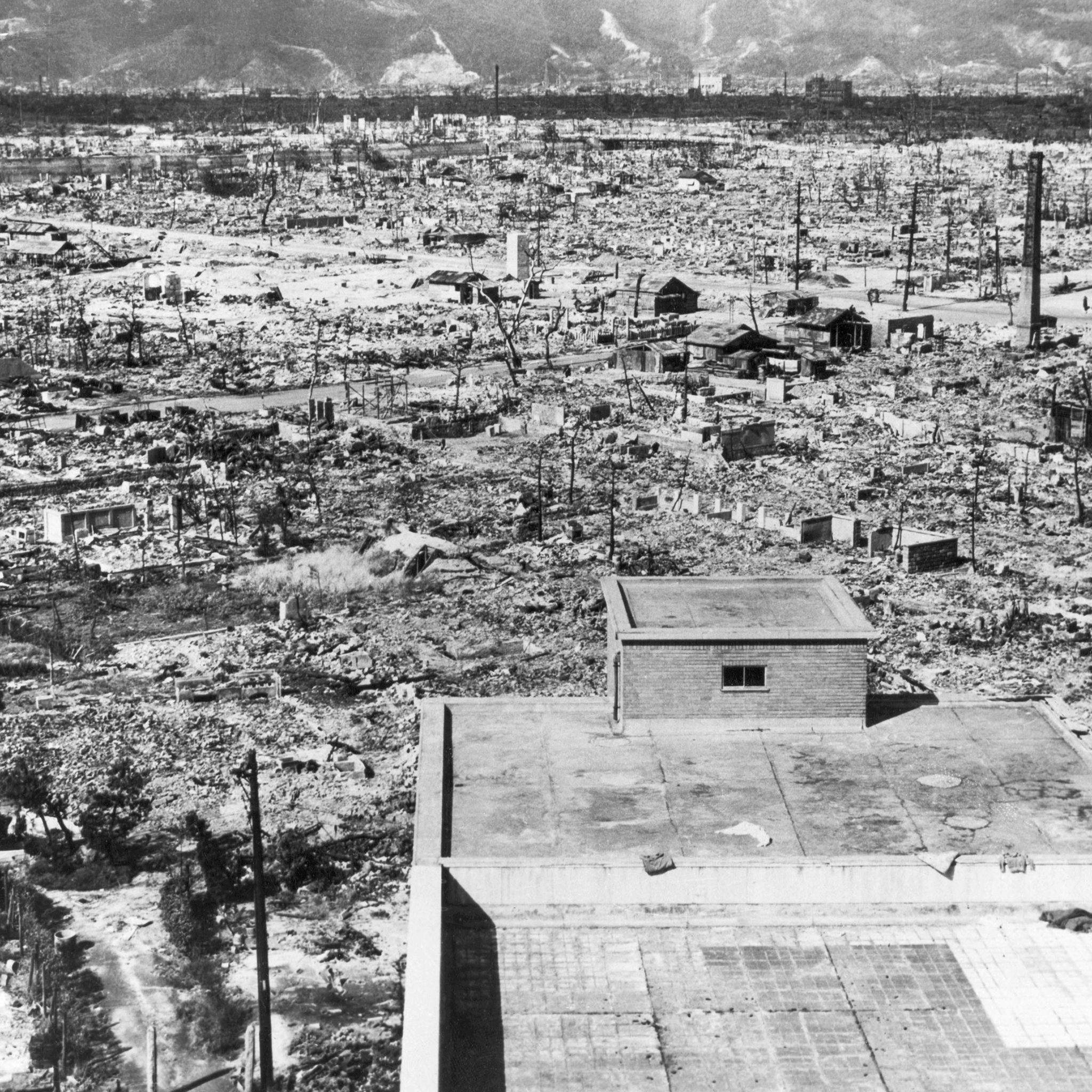
The nuclear physicist’s nightmare is even more horrifying, so much so that Einstein himself said the unleashing of the power of the atom had set us drifting toward “unparalleled catastrophe.”4


File:AtomicEffects-Hiroshima.jpg
                                          

                                                  Hiroshima after atom bombing 

(credit:  https://upload.wikimedia.org/wikipedia/commons/2/2c/AtomicEffects-Hiroshima.jpg) 

Wednesday, 12 April 2017

Good day, faithful followers of this blog space. 

I have been struggling for the last few months with whether or not I should post my book, in manageable segments, of course, one ...last ...time. 

But someone I love very dearly has told me that it is still a bit too esoteric for most ordinary readers. Too many unfamiliar words and unnecessarily long sentences.  

It is ordinary folk who care about what right or wrong are that I want to reach and touch. 

So I swear by all that is holy to me - and I do still believe in God - this really will be the last time I re-write and re-post this manuscript. The changes will be small and they will be intended to make my meaning as crystal clear as I can possibly make it. 

After that, I am going to get a few hundred copies printed, give them to family and friends, and let it go. It has consumed enough of my life. 

The root cause of my obsession is that I do love the human species, my species, and I can see very clearly that it is going in a very bad direction. Moral relativism. Postmodernism. We'll talk about what those are soon. 

Tomorrow we begin again. One last time. And I swear, though I've said this twice before, this really is the last time. 

Keep believing in your ideals. It's the believing itself that really matters. As long as you have that burning in you, you will find your way to truth. We hunger and thirst for what the old texts call "righteousness". I am 67 and I can tell you for certain that does not go away. 

This old man will now do what he can, one more time, to feed that hunger. We cannot live by bread alone; we need some true things to believe in. I think I have found what those are. 

Till tomorrow. 

Peace. 

Monday, 10 April 2017


                                                                (credit: Wikimedia Commons) 


War always seems to be lurking in the wings in this world. Maybe it's because today we have such terrible weapons that all even moderately-educated adults everywhere know we could end civilization on this planet in an afternoon and probably all human life in the next few months. The cockroaches would not miss us. 

But war isn't just a modern human dysfunction. It's been around since shortly after anything like a homo sapiens evolved here. Anthropologists are near certain that the Australopithecine tribes attacked one another as whole tribes. Nothing new here.   

Why is war so deeply embedded in us? 

It is my belief that attacking neighboring tribes, killing most of the adult males, driving off the others, then taking over everything that the losers had - females, kids, food stocks, weapons and tools, etc. - was just one variation of anthropoid group behavior a couple of million years ago. But it proved to be a useful variation in evolutionary terms. Fighting is advantageous for the winners. Stealing is more efficient than working. Tribes that were more inventive with weapons technologies and more aggressive in their memes and behaviors multiplied. The others faded.  

Apes are mostly content to settle into constant, balanced birth-death rates and hegemony in a clear bit of territory and leave it at that. Then came this warlike species, and its war memes and patterns of behavior caused it to rapidly move into a meme variation-driven cultural mode of evolution and so to leave the gene variation-driven way of the rest of the earth's species behind. In short order, as evolution goes, we took over the Earth. No species threatens us now other than ourselves.   

Hitler himself thought that his great insight was this one: "In eternal warfare, mankind has become great; in eternal peace, mankind would be ruined." (Mein Kampf, p. 149) How fully did he believe that? Once he saw that the Germans were going to lose - and in his eyes, they were losing to the Slavs - he ceased to care what happened to Germany. He gave orders to destroy everything. Every bridge, factory, rail line, etc. It was only what losers deserved. (Luckily, in the last months of WWII, Speer was able to largely stymie those orders and Germany was rebuilt in under a decade. But it was Hitler's wish that the German nation die out. His vision was insane, but he did stick to it. That much is clear.) 

Hitler's theories of race are nonsense. Humans are all one species. But if we extend his theories to culture, then they become much more disturbing; they appear to fit reality so closely. 

We humans in our tribes have been competing by war for a long time, and nations who are good at it have risen to dominate the others and to spread the winners' colonies and culture. 

There is hope for our species in evidence which seems to show that pluralistic countries - i.e. ones that can take in and harmonize a lot of different kinds of people - tend to be winners. Rome. Persia. Britain. Russia. The U.S. There are others.   

But the hope embedded in this evidence sounds shaky in these times. Two pluralistic nations confronting each other, escalating through a series of aggressions, and moving to full nuclear strikes would leave the world just as scorched as two more homogeneous superpowers would. There will be little comfort or security in a pluralistic worldview until one such worldview takes in all of us. 

The much older evidence suggests that all of our tribes have acquired a predilection for hate. We are naturally xenophobic. Everywhere people like dividing all the humans there are into "us" and "them". 

There are no naturally tolerant, hospitable tribes. Those values are add-ons acquired in the last less than three thousand years. Not much out of two million years of cultural evolution. 

War kept us strong. But now it is obsolete. 

So? What do we do? 

We begin to teach peace to the kids all over this world as a way of life. Overtly. Everywhere. No more vague, mimsy half-measures. Learn to manage your anger, control your temper, mediate others' disputes, strive to get along, kids. And that is not a suggestion. It's is a required part of your education. Period.  

They can still compete and push themselves to achieve excellence, in their studies, in sports - combative sports in particular - and so on. There is a rational plan for our species that goes on into the future instead of ending in a bloom of mushroom clouds. But it isn't going to be easy to realize. It will take intelligence, will, skills, and cooperation if we're going to get through. 

In the shadow of the mushroom cloud, nevertheless, have a decent day.  


                                                        (credit: Wikimedia Commons) 

Wednesday, 5 April 2017

Apologies to loyal followers of this blog space. I have not posted in a while. I have been taking a 500 level course at UBC Okanagan and I have a paper due on Saturday. It was worrying me, but anyway ...it is now finished. 

I am also working for a landscaping company. Pulling up concrete patio blocks, mowing, raking, weeding, wheelbarrowing gravel. I'm very tired some nights. 

Ah, enough excuses. 


                                                            (credit: Wikimedia Commons) 


I want to discuss today the differences between the meme/belief systems of two cultures whose clash is still going on: the Europeans and the native people of the Americas. 

When Europeans first came to the New World, every tribe had its own distinct memes/beliefs and there were hundreds of tribes. But the biggest shock that Europeans brought to the native way of life was grounded in the worldview expressed by English philosopher John Locke. 

Locke argued that any item, area, etc. became the property of the person who added value to it. If you cut down a tree, then your labor had made that tree available for human use so you should be entitled to sell it for a profit to yourself. If you cleared and farmed a plot of land, that labor made it yours. Whatever you were able to do with it - feed a family, raise a cash crop - was then yours. He was careful to say that when you consume any natural resource you must leave enough for others. There should be no total draining of any resource so that no one gets any from that time on. But to Europeans in those times, North America's lands and forests seemed near infinite. The Europeans meme/belief system was telling them to grab the wealth. 

Work, work, work. Get what you came for; the enjoyment can wait. It might run out someday, but that would be so far in the future that there was no point in even thinking about it now. 

This is a large generalization, I know, but ...generally the native people could not accept this European worldview. How can a person own the land? That is as foolish as talking about owning the air. And why would that person seek to hunt all the game, cut all the trees, plow all the acres, and so on? This would be a desecration, a heresy beyond conceiving by any normal, sane human being. The land was not ownable. It was held in trust for the Great Spirit. It was to be treated with utmost respect. Who could conceive of violating that trust? 

So John Locke on one side and the spiritual beliefs of the native peoples on the other confronted one another not as much in hostility as in disbelief. 

This is how utterly memes limit our thinking at the same time as they enable that thinking. We can only conclude what our range of concepts enables us to conclude. 

The systems of memes foster and produce their respective ways of life. And when the ways of life clash, the stronger wins. That is how cultural evolution works. 

But it is important to note that the stronger isn't always the more pleasant as far as the levels of ambience and joy produced in the populations who are programmed with these different ways of thinking and living. The native peoples of North America probably enjoyed their lives more than their European counterparts did when they first met. But happiness is not the goal of any meme system. Vigor. Population. Technology. Industry. Military might. These are the things that win when the struggle ripens into open warfare. Survival trumps all else.  

The European way of life made population and added effective weapons and military might. It has run roughshod over much of the world for, arguably, the last two centuries at least. 

But if we look at the largest view of this planet and the history of our species on it, we are driven to conclude that the Euro way of thinking, working, living, and fighting is closing in on its logical limits. The resources of this planet aren't infinite. The caveat in Locke's theory of work and value is coming round to bite us. We should leave plenty for the next generation. But that is becoming hard to do under the present market-driven, industrial system and the pressures of so many humans on this planet. 

We are going to need some memes that tell us its time to pull our industrial production and human reproduction back on this planet. The native peoples' belief system and wisdom offers a whole set of such memes to discuss and teach to the children. All of the children. 

We may take our production and reproduction into space. Space stations. Lunar colonies that grow around mines that get minerals from lunar dust. Space stations that hold hundreds of thousands, even millions of human beings, growing their own food, being born, living, and dying generation after generation in space. We may begin the great adventure of spreading our species off of this small world. All of these make for interesting speculation in science fiction novels. 

But on this planet, we are going to have to change our memes and our ways, and the native peoples' memes may very well be the ground on which we build a new social order. 

Here. On Earth. In time. 

In the shadow of the mushroom cloud, nevertheless, have a great day. 


                                                                 (credit: Wikimedia Commons)